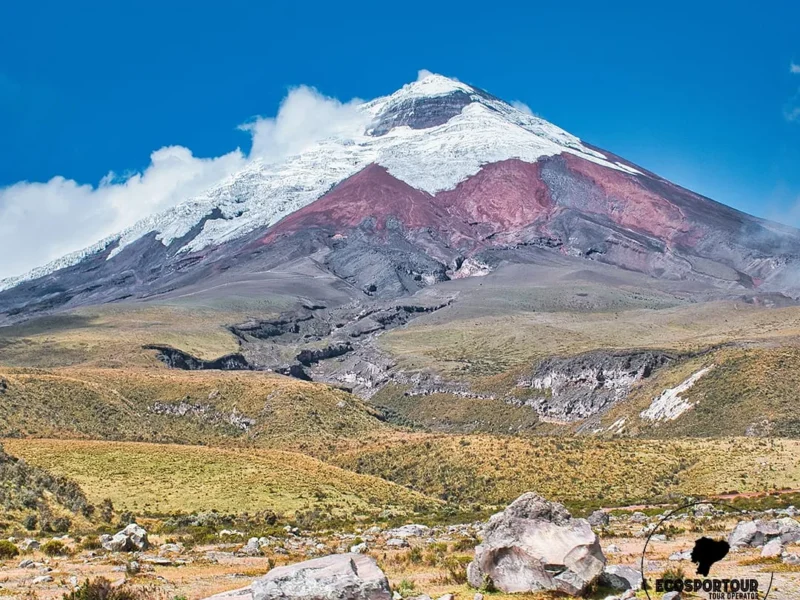
You can leave Quito in a T-shirt and be standing in horizontal wind two hours later. That is not bad luck, it is how the paramo works. Cotopaxi National Park sits 50 km (31 miles) south of the city, and on the tours that go up the volcano our transport reaches a parking lot at 4,600 m, with the walk topping out at the Jose Rivas refuge at 4,800 m (15,748 ft). Nothing about the weather up there is decided by the sky over Quito at breakfast.
The average temperature on our Cotopaxi day tours is around 5C / 41F, and the average is the least useful part of that sentence. In one afternoon you can get full equatorial sun, cloud, wind and hail, and the Cotopaxi packing list that copes with all four is always the same: several thin layers instead of one thick coat.
Why layers beat one big jacket
Air at 4,600 m and above is thin, so it holds very little heat. When the sun goes behind a cloud the temperature falls in seconds, and when it comes back you are overheating in the jacket you were grateful for a minute earlier. Walking uphill on volcanic sand makes you sweat even at 5C, and sweat trapped under a heavy coat is what leaves people shivering at the refuge. Three layers you can open, close and shed beat one warm jacket, which is why the what-to-bring list on our Cotopaxi day tours asks for comfortable, warm clothes and a windbreaker rather than one heroic garment.
The layers that actually work
- Base layer: long-sleeved synthetic or merino. Cotton holds sweat against your skin and stays damp all day.
- Mid layer: fleece or a light insulated jacket. Take it off on the way up, put it back on the moment you stop.
- Windbreaker: it is on the list of every Cotopaxi tour except the summit climb, where we provide the windproof jacket. Wind, not cold, is what visitors underestimate at the refuge, and a shell that also keeps rain out is better.
- Trousers that dry fast: anything synthetic. Jeans soak up drizzle and stay wet all day.
- Gloves, plus neck and ear protection: those three are on the day-tour lists word for word, and a buff plus a warm hat covers the last two.
- Spare socks: leave them in the vehicle. Dry feet at lunch change the whole afternoon.
Shoes are the part people get wrong
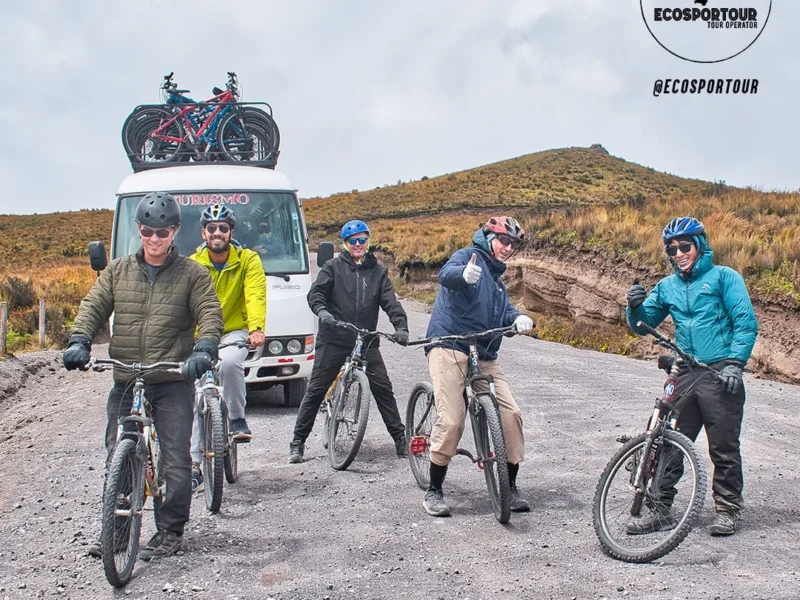
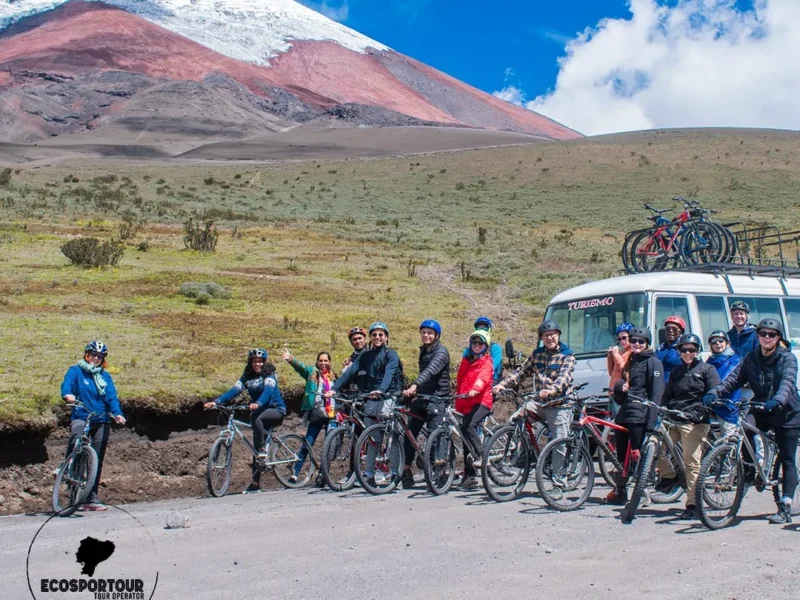
The day-tour lists ask for comfortable shoes for mountainous and sandy terrain. The ground between the parking lot and the refuge is loose volcanic sand and gravel on a steep slope: smooth-soled trainers slide on it and low-cut shoes fill with grit. Bring something with a grippy sole, ideally covering the ankle. The same shoes work for the bike descent: around 45 minutes downhill from that parking lot to the Limpiopungo Lagoon at 3,850 m, bike and helmet ours.
The sun is stronger than the cold
Sunscreen is on the packing list of every Cotopaxi tour we operate, and it is the item people leave behind most often. You are on the equator, above 4,600 m, often with cloud below you reflecting light back up: being cold and burnt on the same afternoon is entirely possible. Sunglasses are on the list for the horseback ride, the two-day trip and the summit climb, and the two-day trip adds a sun hat. Carry both whichever tour you choose.
What changes if you ride instead of walk
Our Cotopaxi Horseback Riding day stays in the lower part of the park: entrance at 3,200 m (10,499 ft), a photo stop at 3,600 m weather permitting, and around three hours in the saddle in the Limpiopungo valley at 3,850 m with a native chagra guide. Lower than the refuge, and not noticeably warmer.
Two things change in your bag. Chaps (zamarro), poncho and helmet are included, so you need no riding gear of your own – wear long trousers underneath and shoes you do not mind scuffing. And sunglasses are on this tour’s list, because three hours in the saddle is three hours with nothing between you and the sky. Breakfast is not included on this one; there is a stop near the park entrance to buy it.
On the Cotopaxi Hike and Bike day, a three-hour horseback ride can replace the hike and the bike descent for $50 extra, arranged in advance.
What changes if you stay the night
On Cotopaxi + Quilotoa 2 Days 1 Night, day one is the refuge at 4,800 m and the bike descent, and you sleep in a tourist-class hotel near Cotopaxi. Day two starts with a hotel pick-up at 8:30 a.m., the Quilotoa viewpoint at 3,900 m (12,795 ft) and about three hours walking down inside the crater to the lagoon and back up to the rim.
Pack a second base layer and second socks: the refuge on day one and the crater on day two produce different kinds of sweat. The list for this tour adds a sun hat and sunglasses to the usual gloves, windbreaker and neck and ear protection. Carry small change as well – the $2 Quilotoa Lagoon ticket and the $1 Toachi Canyon ticket are not included.
What changes if you go for the summit
The Cotopaxi Summit Climb is a different exercise: 5,897 m over two days, leaving the Jose Rivas refuge at 00:30 a.m. for seven to eight hours of slow walking on ice to reach the top at sunrise. The technical equipment is included – plastic boots, crampons, harness, carabiner, helmet, head torch without batteries, two-finger outer gloves, gaiters, ice axe, windproof jacket and trousers, and rope.
What you bring is everything next to your skin: lycra-type base layer shirt and trousers, fleece jacket and trousers, inner gloves, two to three pairs of socks, a buff, sunglasses and sunscreen, a sleeping bag, two backpacks of 40 L and 15 L, and two pairs of AAA batteries for the head torch.
Ready to pack for Cotopaxi?
We operate these Cotopaxi days ourselves, with our own guides and transport, which is why the what-to-bring list on each tour page is the one they actually use. The Cotopaxi Hike and Bike day costs $61, departs Wednesday, Friday, Saturday and Sunday and leaves Foch Square at 7:10 a.m. Browse the rest of our tours from Quito, or send us a WhatsApp at +593 98 094 2338 with what is already in your suitcase and we will tell you straight whether it is enough.