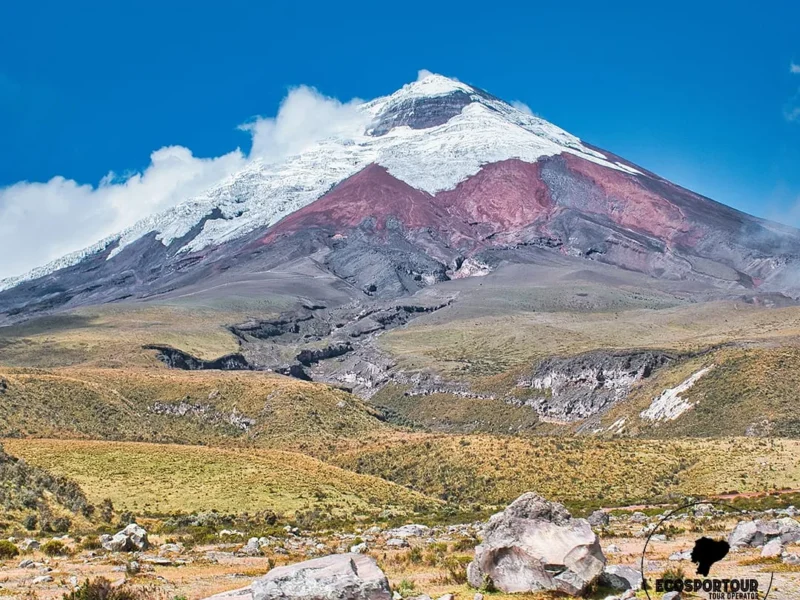
Limpiopungo is the lagoon in almost every photograph of Cotopaxi that is not taken from the snow line: a shallow sheet of water on the open paramo at 3,850 m (12,631 ft), with the cone of the volcano on one side and the broken crown of Ruminahui on the other. It is the flattest and easiest ground in Cotopaxi National Park, and for a lot of travellers it is the part of the day they remember.
This guide covers what the lagoon actually is, what lives around it, how the altitude feels next to the refuge higher up, and the three ways we take people there from Quito.
Where is Limpiopungo?
The lagoon sits on the northern plain of Cotopaxi National Park, in the wide grassland saddle between Cotopaxi itself and Ruminahui, the eroded extinct volcano that closes the view to the north. It is well below the parking lot and the refuge that most day trips aim for, on the same park road, so nobody has to choose between the lagoon and the mountain.
From Quito the drive south along the Pan-American Highway through Machachi takes about an hour and a half to the park on our Cotopaxi Horseback Riding tour. That is a useful benchmark: Limpiopungo is a morning away from the city, not an expedition.
What the lagoon actually looks like
Do not expect an alpine lake. Limpiopungo is shallow, wide and edged with reed beds and soft ground, and its size moves with the rain – in a dry spell the water pulls back and leaves a rim of black peat and grass. Around it the paramo runs flat to the base of both volcanoes: tussock grass the colour of straw, cushion plants low to the ground, and the orange spikes of chuquiragua, the flower Ecuadorian climbers took as their emblem.
On a low hill above the plain stand the ruins of Pucara del Salitre, an Inca-era fort built to watch this pass. The volcano, the ruins and the open paramo are exactly what the horseback route crosses.
What wildlife will you see?
Limpiopungo is the best place in the park to look for animals, precisely because it is water in the middle of a dry grassland. What you are most likely to see:
- Water birds. Andean gulls, Andean coots, Andean teal and Andean lapwings, which spot you long before you spot them and say so loudly.
- Birds of prey. Carunculated caracaras walking the grass on foot, and hawks working the slopes above the plain.
- Hummingbirds. The Ecuadorian hillstar, which survives at this altitude largely on chuquiragua.
- Mammals. White-tailed deer, the occasional Andean fox, and the half-wild horses that graze the plain.
None of it is guaranteed. This is wild paramo, not a reserve with feeding stations. But the lagoon concentrates life in a way the rest of the plain does not.
Three ways we get you to Limpiopungo
We run all three ourselves, so these are the real numbers:
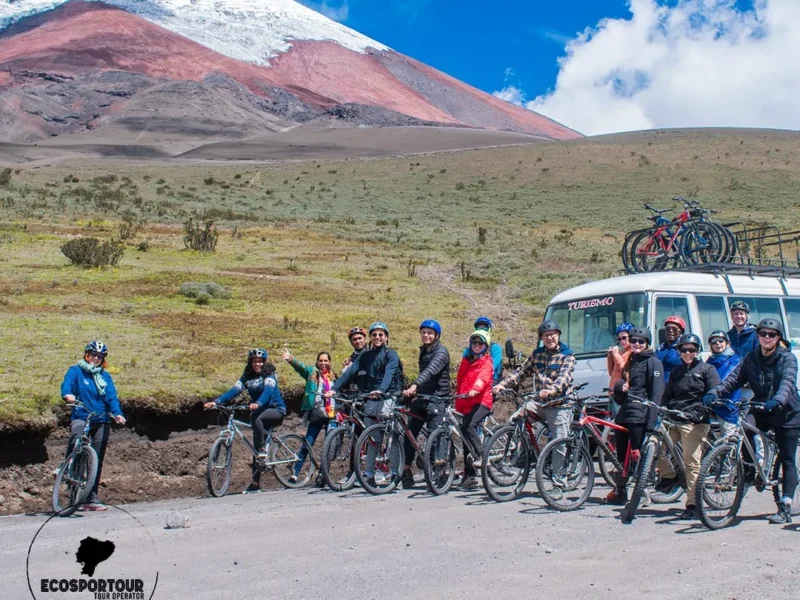
- Cotopaxi Hike and Bike – $61, 10 hours. The day climbs to the Jose Rivas refuge at 4,800 m, and then around 45 minutes of downhill biking from the parking lot at 4,600 m finishes at Limpiopungo at 3,850 m. Bike and helmet, a menu-type lunch and the protected area entrance permits are included. Departs Wednesday, Friday, Saturday and Sunday.
- Cotopaxi Horseback Riding – $112, full day. Roughly three hours in the saddle around the Limpiopungo valley with a native chagra guide, returning to the same point where you mounted. Chaps, poncho and helmet, lunch and the park permits are included; breakfast is not, though there is a stop near the entrance where you can buy it. Same four departure days.
- Cotopaxi + Quilotoa, 2 days 1 night – $152. Day one is the refuge hike and the optional bike descent to Limpiopungo; you sleep at a tourist-class hotel near Cotopaxi and day two is the Quilotoa crater. Departs Tuesday, Wednesday, Thursday and Saturday, and it is confirmed from a single passenger.
All three leave Quito from Foch Square at 7:10 a.m. or from Zular Coffee Shop on San Blas Square at 7:20 a.m. On the second morning of the two-day trip you are collected at the hotel at 8:30 a.m. instead.
How does 3,850 m feel?
Manageable for most people. Quito already sits at 2,850 m, so if you have had a day or two in the city, the extra thousand metres at the lagoon is noticeable rather than punishing: you walk more slowly, you breathe harder on the smallest rise, and that is usually the whole of it. The ground around the water is flat, which is why Limpiopungo works so well as a first day at altitude.
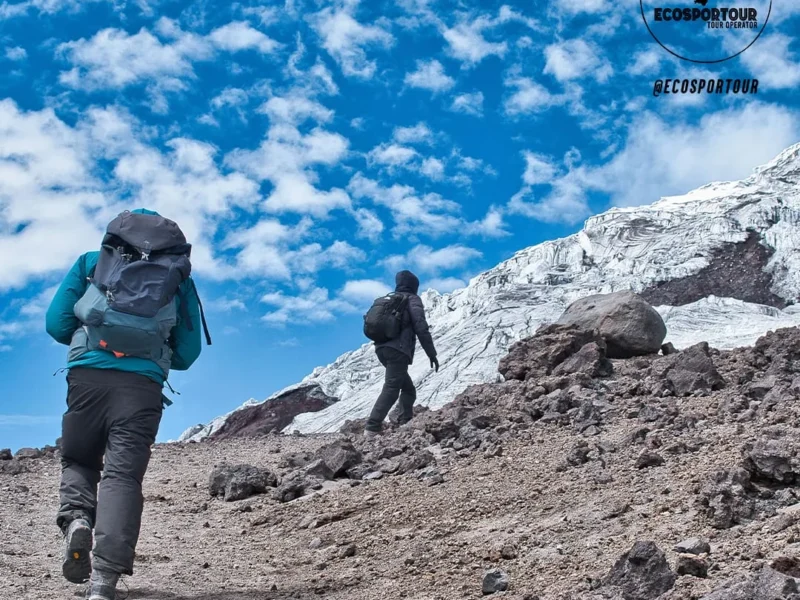
The demanding part of a Cotopaxi day is not the lagoon, it is the refuge at 4,800 m, almost a kilometre higher up. If the altitude worries you, the horseback tour is the honest answer: it stays in the lower part of the park and never goes near that number.
At the other extreme, our Cotopaxi Summit Climb is a two-day trip in the same national park that begins with an equipment check at our Quito office at 10:30 a.m., sleeps at the Jose Rivas refuge and leaves for the ice at 00:30 a.m. Different sport, same volcano.
What to wear and bring
Average temperature on our Cotopaxi days is around 5C / 41F, and the plain is open in every direction, so the wind matters more than the thermometer. Pack:
- Comfortable, warm layers and a windbreaker
- Gloves, plus neck and ear protection
- Sunglasses and sunscreen – the light at this altitude burns even under cloud
- Comfortable shoes for mountainous, sandy terrain
- A camera, and binoculars if you have them
One more thing worth knowing: the volcano makes its own weather. Mornings are generally the clearest part of the day and the cloud tends to build later, which is why the departures from Quito are early rather than civilised.
See Limpiopungo for yourself
We are a Quito operator with fifteen years in these mountains, our own transport and our own guides, which is why the entrance permits, the lunch and the bike sit in the price instead of in the small print. Check dates on the Cotopaxi Hike and Bike page or the Cotopaxi Horseback Riding page, browse the rest of our tours from Quito, or send us a WhatsApp at +593 98 094 2338 and tell us how much altitude you want in your day – we will tell you straight which of the three fits you.