Ask when to come to Cotopaxi and the useful answer is not a month. The volcano keeps its own schedule: the glacier cone is often out at breakfast and buried in cloud by mid-afternoon, in August as much as in April.
So the question splits in two: which season gives you the best odds, and which hour of the day gives you the view. The best time to visit Cotopaxi is really an answer with two halves, and this guide covers both, plus what changes if you come on foot, on horseback or on ice.
The best time to visit Cotopaxi starts with one fact: there is no summer here
Ecuador sits on the equator, so day length barely moves: light around six in the morning, dark around six in the evening, in January as in July. What changes is moisture, not daylight and not really temperature.
- Drier months: roughly June to September, with a second clearer spell around December and January.
- Wetter months: roughly February to May, and again in October and November.
- Unchanged all year: the cold at altitude. Average temperature on our Cotopaxi day tours is around 5C / 41F, whichever month you pick.
Treat those as tendencies, not a timetable. The paramo above 3,500 m makes its own weather, and a clear week in April is as possible as a clouded-in week in July.
One thing no calendar covers: Cotopaxi is an active volcano, and access to parts of the park can be restricted at short notice for reasons that have nothing to do with rain. Message us if you are booking months ahead.
June to September: the classic window
This is the driest stretch of the year in the central Ecuadorian Andes and the one most visitors aim for. Cloud tends to break earlier in the day, which is what you want when the point is to stand at the Jose Rivas refuge and look up at a glacier.
The trade-off is wind. These are the windiest months on the mountain, and at 4,800 m the wind is what people underestimate, far more than the cold. It is also the busiest stretch, so midweek is calmer.
December and January: the second clear spell
The other window falls around December and January, when the rain usually eases and the light is superb. Less reliable than the mid-year spell, but the wind is softer and the mountain quieter, apart from the holidays at the turn of the year.
February to May and October to November: does the rain spoil it?
Less than you would think. Rain in the Andes tends to build through the day rather than fall all morning, and a day tour from Quito is built around that: you are at altitude early and heading down as cloud thickens. What you get in exchange:
- Green paramo. The high grassland is at its most alive, and Limpiopungo carries more water.
- Fewer people. Quieter trails and viewpoints, photographs without anyone else in them.
- Less wind. The gales of the dry season generally ease off.
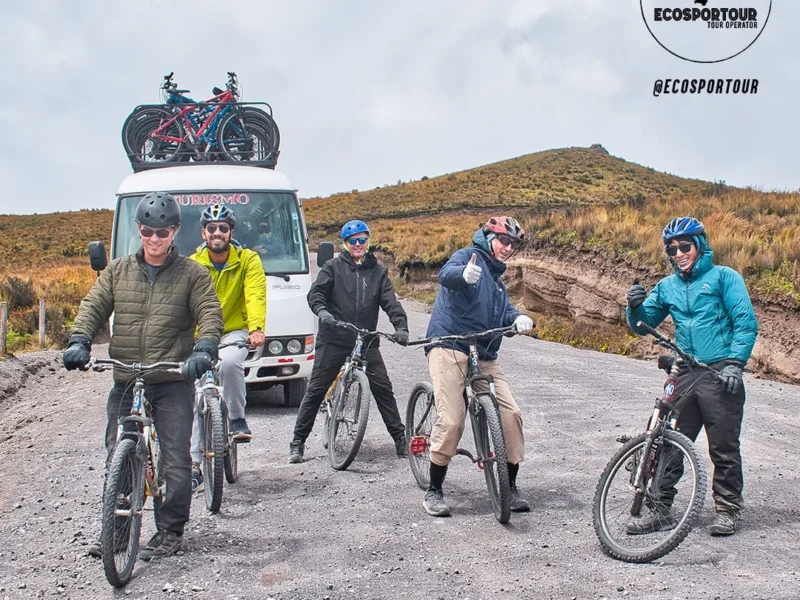
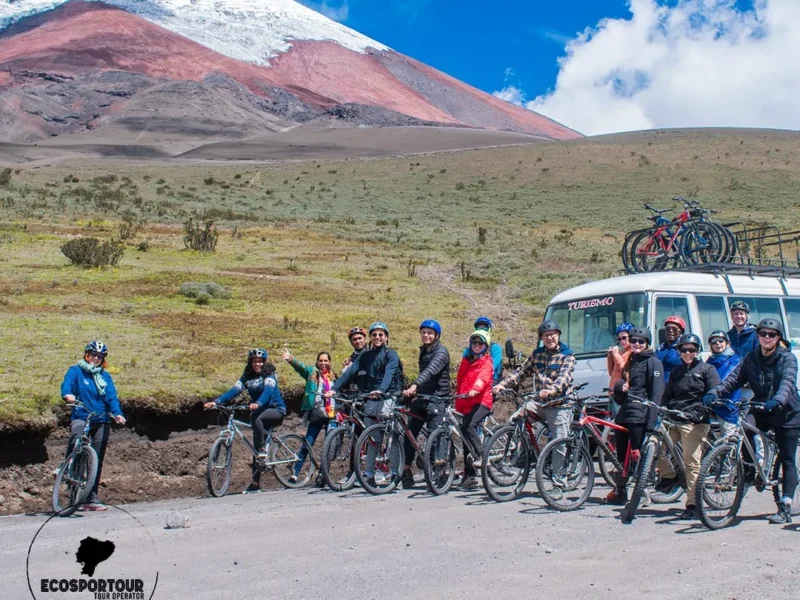
You lose nothing on the bike either: the descent is optional. On our Cotopaxi Hike and Bike the 45-minute downhill run to the Limpiopungo Lagoon at 3,850 m includes bike and helmet, and if the weather turns you ride down in the van instead.
And if you would rather not be high on the cone at all, our Cotopaxi Horseback Riding day stays around the Limpiopungo valley at 3,850 m instead of climbing to the refuge, with chaps, poncho and helmet provided.
Why the hour matters more than the month
If you take one thing from this page, take this: mornings win. Cloud builds over the cone as the day warms, so the gap between 9 a.m. and 3 p.m. is usually wider than the gap between June and April. These days start early by design, not by habit.
- Cotopaxi Hike and Bike. Pick-up at Foch Square at 7:10 a.m. or Zular Coffee Shop on San Blas Square at 7:20 a.m., Wednesday, Friday, Saturday and Sunday. A 10-hour day, $61 per person.
- Cotopaxi Horseback Riding. Same pick-up points and times, same four days. A full day with roughly three hours in the saddle alongside a native chagra guide, $112 per person.
- Cotopaxi and Quilotoa in two days. Departures Tuesday, Wednesday, Thursday and Saturday, with day two starting at 8:30 a.m. from a hotel near the volcano rather than before dawn in Quito, $152 per person.
When to climb to the summit
For the glacier itself the calendar tightens up. The drier windows are the traditional high-altitude climbing seasons in Ecuador: a summit day depends on wind and on the state of the ice, not on rain alone.
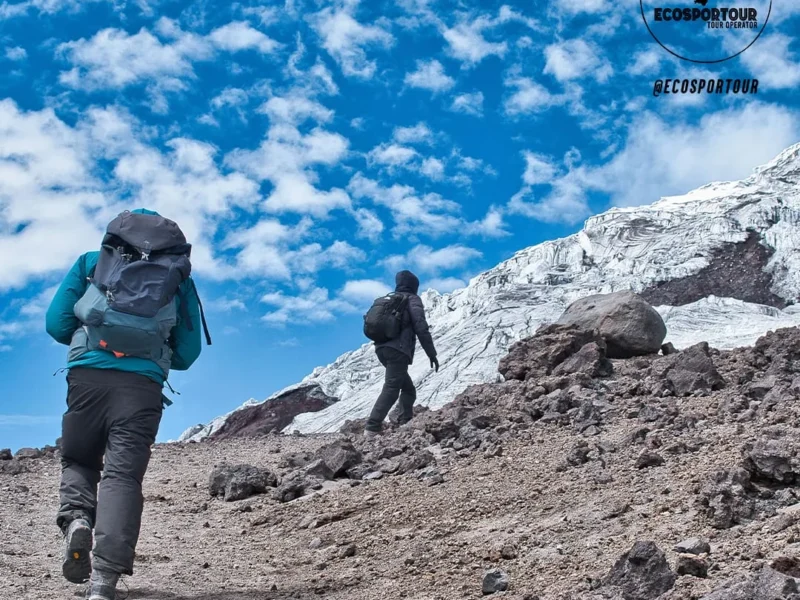
Our Cotopaxi Summit Climb runs every day with a minimum of two climbers, or as a private departure for one, so the season is not what limits you. Acclimatization is. It is a two-day trip at $405 per person: you meet your ASEGUIM-certified guide at our Quito office at 10:30 a.m., sleep at the Jose Rivas refuge at 4,800 m, set off at 00:30 a.m. and walk seven to eight hours on ice to reach the top at sunrise, between 6 and 7 a.m. Its glacier school runs weather permitting, one more reason the drier months are kinder.
What to wear, in any month
The packing list barely changes with the season – 4,800 m is cold and bright whatever the calendar says. For a day tour:
- Warm, comfortable layers and a windbreaker
- Gloves, neck and ear protection – the wind again
- Sunscreen and sunglasses – the equatorial sun burns at this altitude even while you shiver
- Shoes for mountainous, sandy terrain
- A camera, and patience for the cloud to open
Lunch and the protected area entrance permits are already covered on both Cotopaxi day tours. Breakfast is not part of the horseback day, but there is a stop near the park entrance where you can buy it.
So what is the best time to visit Cotopaxi?
If you want it in one line: the best time to visit Cotopaxi is a dry-season morning, and the morning matters more than the month. We operate these Cotopaxi days ourselves, with our own transport and our own bilingual guides, which is why we can tell you honestly what a given week tends to look like instead of selling you the next free seat. Check dates on the Cotopaxi Hike and Bike page, compare it with the rest of our tours from Quito, or send us a WhatsApp at +593 98 094 2338 with your travel dates.