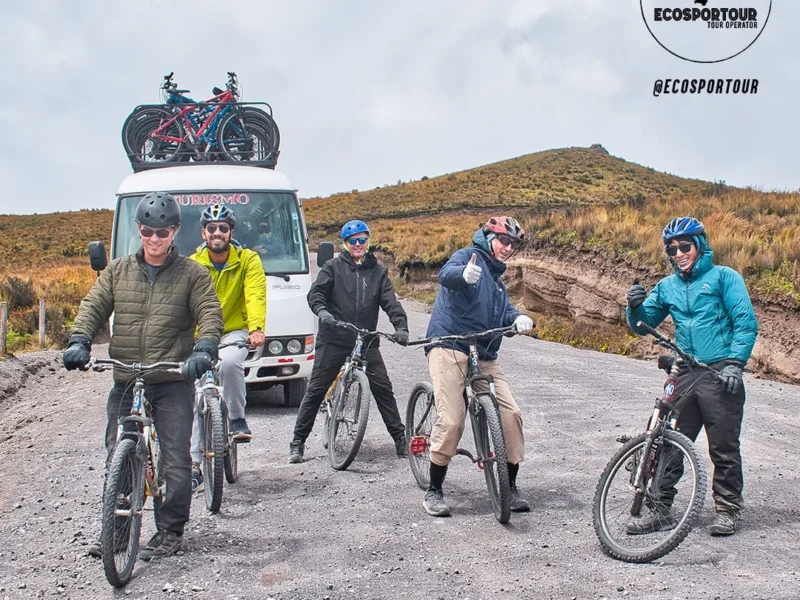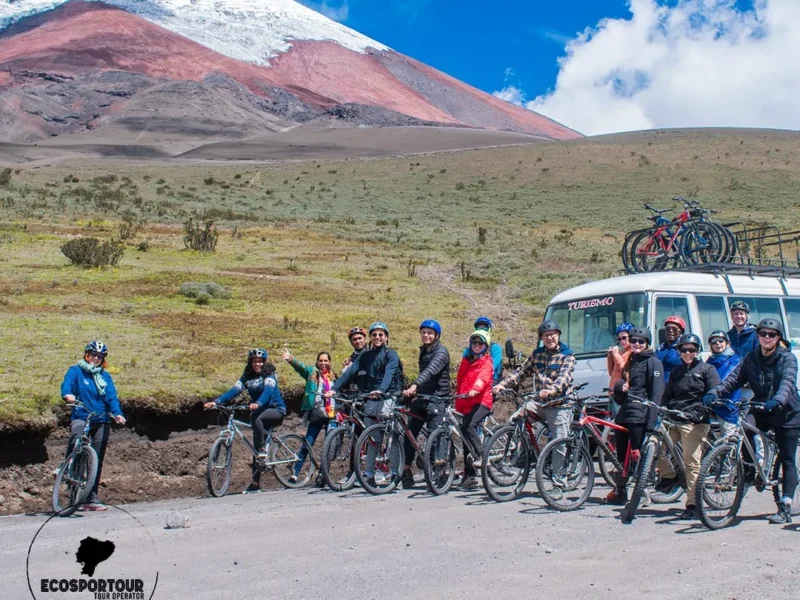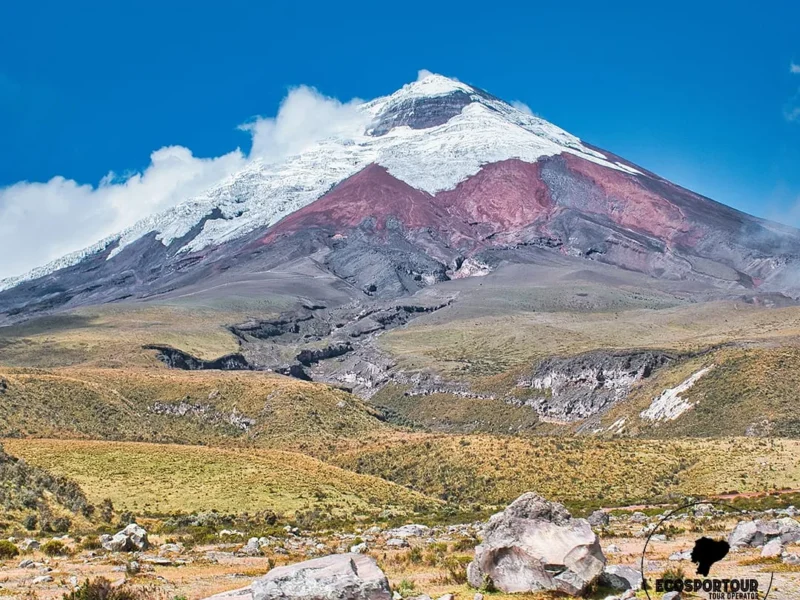
A Cotopaxi hike and bike day does not make you choose. Most adventure days do: you either walk and earn the altitude, or ride and enjoy the speed. This one gives you both in the same morning: you hike up the sandy flank of one of the highest active volcanoes in the world to the Jose Rivas refuge at 4,800 m (15,748 ft), come back down to the parking lot, and there you get on a bike and let gravity carry you to 3,850 m.
That is the whole logic of our Cotopaxi Hike and Bike: a 10-hour day from Quito, rated moderate, $61 per person on a shared departure. Here is why the combination works, what each half actually feels like, and how to tell whether it is the right day for you.
Why the combination works
Cotopaxi rises to 5,897 m (19,347 ft), and its national park is the second most visited protected area in Ecuador after the Galapagos. Any single activity only shows you one slice of it.
A hike on its own gives you the thin air and the view from the refuge, but it keeps you inside a few hundred metres of trail. A bike descent on its own gives you the wind and the speed, but never the altitude. Put them back to back and you cover the whole vertical range of the park in one day: volcanic sand and bare rock above, paramo grassland and a lagoon below. It also balances the effort: you climb slowly all morning, then spend nothing at all on the way down.
The climb: 4,600 m to the refuge
What surprises most people is how much of the altitude is done for you. Our transport drives all the way to the parking lot at 4,600 m (15,092 ft), so the serious gain happens while you are sitting down. On foot you climb to the Jose Rivas refuge at 4,800 m, the highest point of the day, and then walk back to the parking lot.
There is no technical equipment involved and no previous experience required. This is a walk on a steep, sandy volcano, not a climb. What limits you is not your legs, it is the air: above 4,600 m every step costs more than it does at sea level, so go slowly and deliberately from the first metre and tell your guide immediately if you get a headache. If uphill walking is not your idea of a holiday, a three-hour horseback ride replaces the hike and the bike descent for $50 extra, booked in advance.
The descent: 45 minutes downhill to Limpiopungo
The bike leg starts at the same parking lot where the hike began and runs around 45 minutes downhill to the Limpiopungo Lagoon at 3,850 m (12,631 ft). That is roughly 750 metres of vertical drop you do not have to walk, with the paramo opening out in front of you and the cone of the volcano behind your shoulder.
Bike and helmet are included in the price, and the descent is optional. If you would rather stay in the van and watch the mountain through the window, nobody minds.
How the day is put together
- 7:10 a.m. Foch Square. Or 7:20 a.m. at Zular Coffee Shop on San Blas Square.
- 2,945 m. Acclimatization stop, with Pasochoa, Ruminahui, Corazon and the Ilinizas on the skyline.
- 4,600 m. The parking lot, where the hike begins.
- 4,800 m. The Jose Rivas refuge, the highest point of the day.
- 3,850 m. The Limpiopungo Lagoon, where the bike descent ends.
- Lunch and back to Quito. A menu-type lunch is included, and you are back in the city by evening.
Who this day suits
- Best for: travellers who want genuine high-altitude scenery without ropes, crampons or a night on the mountain.
- Best for: anyone who gets restless doing one thing all day. You go from 2,945 m at the first stop to 4,800 m at the refuge, then ride back down to a lagoon.
- Best for: mixed groups. The bike descent is optional and a horseback ride can stand in for both halves, so a difference in fitness need not split the day.
- Not ideal if: you landed in Quito yesterday. Give yourself a day or two at 2,850 m before you go up.
- Not ideal if: the summit is what you came for. That is a separate trip entirely, and it is listed below.
What is included and what to pack
The $61 covers the bilingual Spanish-English guide, authorized tourist transportation, a menu-type lunch, the bike and helmet, and the protected area entrance permits. Extra food and drinks, snacks and gratuities are not included.
Average temperature on the tour is around 5C / 41F, and at 4,800 m the wind is the part people underestimate. Bring:
- Layers: comfortable warm clothes and a windbreaker
- Extremities: gloves, plus neck and ear protection
- Sunscreen: the sun at this altitude is fierce even when the air is cold
- Footwear: comfortable shoes for mountainous, sandy terrain
- A camera: the light on the cone changes by the minute
Prefer a horse, or a second day?
Same volcano, three other ways to meet it:
- Horses instead of pedals. The $50 add-on above swaps the hike and the bike descent for three hours on horseback, arranged in advance. If riding is the whole point of your day, our Cotopaxi Horseback Riding is a full day built around three hours in the saddle with a native chagra guide, from $112.
- Two days instead of one. Cotopaxi + Quilotoa 2 Days 1 Night keeps the refuge and the bike descent and adds the emerald crater lake of Quilotoa, with a night at a hotel near Cotopaxi and an 8:30 a.m. start on day two. From $152, departing Tuesday, Wednesday, Thursday and Saturday.
- The summit itself. Cotopaxi Summit Climb is a different sport: two days, an ASEGUIM-certified guide, crampons and rope, a night at the refuge and a 00:30 a.m. start on the ice. From $405.
Ready to hike up and ride down?
We operate this day ourselves, with our own guides and our own transport, which is why we can tell you plainly what the day really involves instead of reading it off a brochure. Departures run Wednesday, Friday, Saturday and Sunday. Check dates and book on the Cotopaxi Hike and Bike page, compare it against the rest of our tours from Quito, or send us a WhatsApp at +593 98 094 2338 and we will tell you straight whether this is the right day for your trip.