Otavalo sits two hours north of Quito, and most visitors come for the market. What they find is older and larger than a market. It is one of the most recognizable indigenous peoples in the Americas, still speaking Kichwa and still weaving. Also, they still live in a valley between two mountains they treat as family.
This guide covers who the Kichwa Otavalo are and what you are looking at in the Plaza de los Ponchos. Then it shows how it all fits into one day from Quito.
Who are the Kichwa Otavalo?
The Otavalos are a Kichwa-speaking people of Imbabura province, in the northern Ecuadorian Andes. Their reputation rests on cloth. Weaving here predates the Inca. Under Spanish rule it went into the obrajes, the colonial textile workshops, by force. Then, in the twentieth century, the community turned that same skill into a business it owns itself. Otavalo traders sell their textiles and their music in Bogota, Madrid and Tokyo, and then come home to the valley. History pushed most Andean cultures into choosing between staying and leaving. This one refused to.
Kichwa, the Ecuadorian branch of the Quechua family, is a living language here. People speak it alongside Spanish at home and across the stalls. Two words go a long way: alli puncha, good morning, and yupaychani, thank you.
The dress, and what it tells you
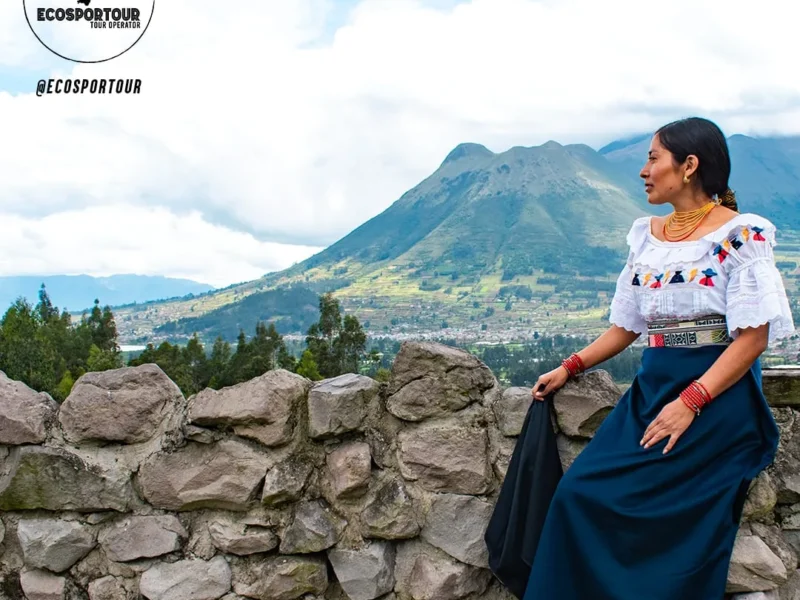
Otavalo dress is not a costume brought out for visitors. It is what people wear to work, to school and to town. Also, it is one of the most complete surviving indigenous outfits in South America.
- Men: white calf-length trousers, a dark poncho, alpargatas or woven sandals, and a felt hat. Very often there is also a single long braid, the shimba, kept as a deliberate mark of identity.
- Women: a white blouse embroidered with flowers at the neck and cuffs. Then come two anacos, the wrapped skirts, one pale and one dark. Two woven belts wound tight around the waist hold them.
- The fachalina: the shawl folded over the shoulders or the head, plain for daily use and bright on feast days.
- Walka and maki watana: strands of small golden beads at the throat and red beads wound around the wrists. Worn every day, not saved for ceremonies.
That is the context a poncho comes out of when you buy one in the market. It is a working garment long before it is a souvenir.
What the Plaza de los Ponchos really is
No indigenous handicraft market in South America is larger or more important. Our Otavalo Cultural and Shopping day trip runs on Tuesdays and Saturdays, the days of the biggest fair. That is when artisans come down from across the region. The free time you get in the plaza is the centre of that day. It is not a stop on the way to something else.
Buy with your eyes on the making rather than the label:
- Ask about the weaving. A backstrap loom, a treadle loom and a machine produce very different objects at very different prices. Sellers will tell you if you ask.
- Check the fibre. Sheep wool, alpaca blends and acrylic share the same stall. Feel the weight and check the back of the weave.
- Carry small bills. Ecuador uses the US dollar, and small denominations make everything easier.
- Bargain gently. Some negotiation is normal. However, grinding someone down over a dollar is not, when you are buying from the person who made the thing.
- Ask before photographing people. Always, and take no for an answer. The plaza is a workplace, not a set.
The equator, the sun and the Andean year
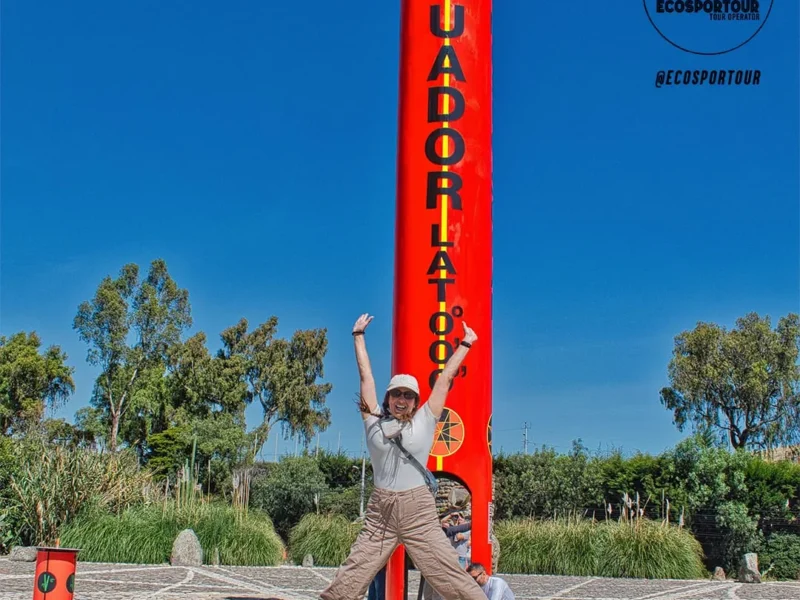
On the way north the day stops at the Quitsato solar clock, built to track the solstices and the equinoxes. There, the equator line runs across the summit of Cayambe. It is the right stop to make before Otavalo, because the calendar the Kichwa still keep is a solar one. The year stays tied to planting, harvest and the position of the sun.
That calendar surfaces in the festivals. First, Inti Raymi, the sun festival, around the June solstice. Then Pawkar Raymi, the flowering festival, in February around carnival. Finally the Yamor, Otavalo’s own September celebration, built on a fermented drink made from several varieties of maize. Festival weeks change the town completely, so ask us before you fix dates around one.
Taita Imbabura and Mama Cotacachi
The two mountains flanking the valley are not scenery here. Imbabura is Taita, the father, and Cotacachi is Mama, the mother. Also, people explain the weather they trade between them in exactly those terms. You see Imbabura standing behind the water at the San Pablo Lake viewpoint, on the way in.
The afternoon belongs to Cuicocha Lagoon at 3,068 m, an active volcanic crater with domes rising out of the water. Then come around 45 minutes in Cotacachi itself, a town that lives from leather. The walks at the lagoon are short: this is a cultural day, not a hiking day.
How to see it in one day from Quito
Ours is a 12-hour day, rated easy, at $56 per person. Pick-up is at Foch Square at 7:10 a.m., or at Zular Coffee Shop on San Blas Square at 7:20 a.m. The tour runs Tuesdays and Saturdays.
- Six stops: a bizcocho bakery in Cayambe, the Quitsato solar clock and the San Pablo Lake viewpoint. Then the Plaza de los Ponchos, Cuicocha Lagoon and Cotacachi.
- Included: bilingual Spanish-English guide, authorized tourist transportation, a menu-type lunch and the protected area entrance permits.
- Not included: the $5 Quitsato ticket, extra meals and drinks, snacks and gratuities.
- What to bring: comfortable clothes and shoes, sunglasses, a sun hat, sunscreen and a camera.
- Weather: around 14C / 57F, at an average elevation of 2,500 m.
If you would rather walk than shop
The same valley holds two of the best acclimatization hikes in Ecuador, both moderate, both non-technical, both $130 per person. Fuya Fuya at 4,290 m rises above the Mojanda lakes, 17 km south of Otavalo. It takes its name from the Kichwa word fuyu, cloud. You climb Imbabura itself, around 4,630 m, from the indigenous community of Casha Loma at 3,500 m. Count roughly 5 hours up and 3 hours 30 back down the same route.
Meet the Otavalos on a market day
We have been running days out of Quito for fifteen years, with our own guides and our own transport. So we can tell you straight which day suits you. Check dates and book on the Otavalo Cultural and Shopping page, or look through our tours from Quito. Then send a WhatsApp to +593 98 094 2338 and ask us anything before you commit.