In the Andes of Ecuador, indigenous markets are not attractions that also happen to sell things. A market is the day a whole valley does its business: potatoes and barley from the paramo traded against bananas, cacao and citrus from the lowlands, plus everything a farming family buys once a week.
Two of those markets sit on the road from Quito to the Quilotoa crater, and which one you see depends entirely on the day you travel. Here is what happens at each, what the painters of Tigua add further along the route, how Otavalo differs, and how to pick your day.
What the indigenous markets of Ecuador are really for
Ecuador stacks climates on top of each other. In a few hours of driving you go from paramo grassland above 3,500 m to subtropical valleys where cacao grows, and no community produces everything it needs. The weekly market is where those layers meet.
The market stop on our Quilotoa route exists for trade, not for visitors. Nobody has arranged anything for you: you are walking through somebody else’s Thursday.
- Animals first. The livestock section opens earliest and empties earliest, and it is the loudest and muddiest part of any highland market.
- Then the produce. Grains, potatoes in more varieties than you knew existed, herbs sold by the handful, and the fruit that came up from the lowlands.
- Then everything else. Wool, hats, rope, buckets, tools and counters where people eat standing up.
Saquisili on Thursdays, Pujili on Sundays
Our Quilotoa Culture and Hike opens the day at the market, well before the crater. It is a 12-hour day rated moderate, with pick-up at Foch Square at 7:10 a.m. or at Zular Coffee Shop on San Blas Square at 7:20 a.m., and it runs Tuesday, Thursday and Sunday.
Which market you get is set by the calendar, not by the tour:
- Thursday – Saquisili. The Thursday fair spreads across several plazas, each given over to a different kind of trade, and people come down from the surrounding communities at first light.
- Sunday – Pujili. Sunday belongs to Pujili, a town further along the same road, working on the same logic: highland produce traded against lowland produce.
- Best for: travellers who would rather watch a local economy work than go shopping.
The stop happens in the morning, and that matters: highland markets are busiest early and thin out by midday. It is why the pick-up is at 7:10 a.m. and not at nine.
Tigua, where the canvas is a sheepskin
Further along the same road is Tigua, where sheepskin is the canvas. The animal faces painted on it in strong colour carried the name of Tigua well beyond Ecuador, and its wood carvers have the same reputation.
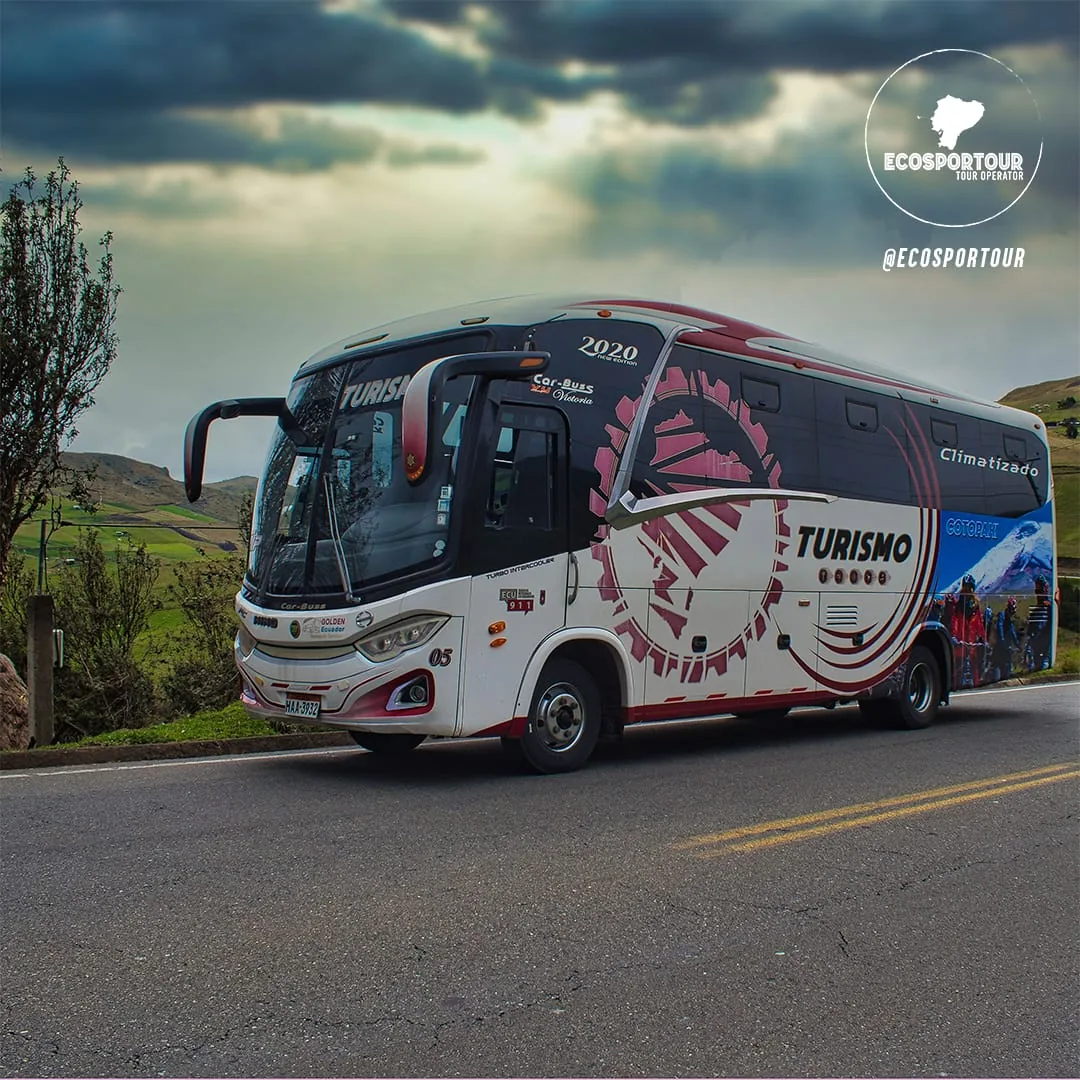
How you meet the work depends on the trip. The one-day Quilotoa tour stops at the gallery. On the two-day Cotopaxi and Quilotoa version the painters come aboard the bus on the second morning; if they do not, the bus stops at the gallery. Either way, bring cash in small notes: nothing you buy at a market or in Tigua is part of the tour price.
Otavalo is a different kind of market
If you want textiles to take home, the market to plan around is not on the Quilotoa road at all. The Plaza de los Ponchos in Otavalo is the largest and most important indigenous handicraft market in South America, and our Otavalo Cultural and Shopping day is built around the free time you get there.
- Days: Tuesdays and Saturdays, when the fair is at its biggest and draws artisans from across the region.
- Difficulty: easy, 1 out of 5. Still a 12-hour day, but a relaxed one with short walks.
- Also in the day: the bizcocho ovens in Cayambe, the Quitsato solar clock on the equator line, the Cuicocha crater lagoon at 3,068 m, and around 45 minutes in Cotacachi, a town that lives from leather.
- Best for: shopping, photographs and anyone who does not want a hike.
Same pick-up points and times as the Quilotoa day, and the same $56 per person, which covers a bilingual Spanish-English guide, authorised tourist transport, a menu-type lunch and protected area permits. The one ticket to carry cash for is the $5 Quitsato entrance.
Which day should you travel?
- Thursday. Quilotoa plus the Saquisili market, on the Quilotoa Culture and Hike.
- Sunday. Quilotoa plus the Pujili market, same tour, same $56.
- Tuesday. Both days run: Quilotoa Culture and Hike, and Otavalo Cultural and Shopping.
- Saturday. Otavalo on one of its two fair days.
One honest caveat: the Quilotoa tour also departs on Tuesdays, but the only market days named on its itinerary are Thursday and Sunday. If the market is your reason for going, book one of those, or message us and we will tell you what a Tuesday departure stops at.
What to bring, and how to behave
Average temperature on the Quilotoa day is around 12C / 54F at an average elevation of 3,800 m; on the Otavalo day it is around 14C / 57F at an average of 2,500 m. Markets are outdoors and highland mornings are cold. The two days do not ask for the same bag:
- Quilotoa day: comfortable, warm clothes, a windproof jacket, gloves and neck and ear protection, and comfortable shoes for walking in mountainous and sandy terrain.
- Otavalo day: comfortable clothes and shoes; there is no hike in this one.
- Both days: sunglasses, a sun hat, sunscreen and a camera.
- Cash: small notes for anything you buy.
- Manners: ask before you point the camera at somebody.
Haggling belongs in the craft aisles of Otavalo, not in a plaza where a family is selling the sheep it raised. And on the Quilotoa day the rest of the cash you need is specific: $2 for the lagoon entrance, $1 for the Toachi Canyon, plus $3 if you kayak and $10 if you take a horse back up from the shore. Guide, transport, lunch and permits are already inside the $56, and the full picture of that day is in our Quilotoa guide.
Pick your market day with the people who run the tour
Fifteen years operating in Ecuador with our own guides and our own transport is why we can tell you which of these indigenous markets falls on your dates instead of guessing. Check departure days and book on the Quilotoa Culture and Hike page, compare it with the Otavalo Cultural and Shopping day, browse the rest of our tours from Quito, or send us a WhatsApp at +593 98 094 2338 with your dates.