Laguna Cuicocha is what a volcano looks like once it has finished collapsing. The crater filled with water, then two lava domes pushed back up through the middle. So what you get today is a deep blue lake with two green islands in it. It sits at 3,068 m (10,066 ft) at the foot of Cotacachi volcano.
Almost nobody comes north for it alone. Instead, Cuicocha is usually the afternoon half of a day that starts in the Otavalo market. Here is what is up there, how much walking it involves and how to visit from Quito.
What exactly is Laguna Cuicocha?
Cuicocha is a caldera. The top of an old volcano blew out and dropped, and the bowl left behind filled with water. The two islands in the middle are lava domes that rose afterwards. Meanwhile, the narrow channel between them carries the name Channel of Dreams. The system is not extinct: gas still rises through the water in places. This is not a swimming lake, and the islands stay closed to visitors.
The name is Kichwa: kuy is guinea pig, kucha is lake. So Cuicocha usually translates as the Lake of the Guinea Pigs, after the shape of the larger island. The crater sits inside the Cotacachi-Cayapas Ecological Reserve. Also, it is a ceremonial site for the Kichwa communities of Cotacachi and Otavalo. They bathe here during Inti Raymi in June.
How do you get to Cuicocha from Quito?
Otavalo is two hours from Quito by direct bus. Cuicocha lies beyond it, past the town of Cotacachi and up to the rim. Public transport gets you to Cotacachi but not to the crater. So independent travellers end up negotiating a taxi for the last stretch.
Our Otavalo Cultural and Shopping tour builds the lagoon into a 12-hour day that runs on Tuesdays and Saturdays. Pick-up is at Foch Square at 7:10 a.m. or Zular Coffee Shop on San Blas Square at 7:20 a.m. The shared tour costs $56 per person. Also, the difficulty carries an easy rating, 1 out of 5.
Cuicocha is the fifth of six stops, and none of the other five is filler:
- Cayambe: bizcochos straight out of the oven, with Ecuadorian coffee or hot chocolate.
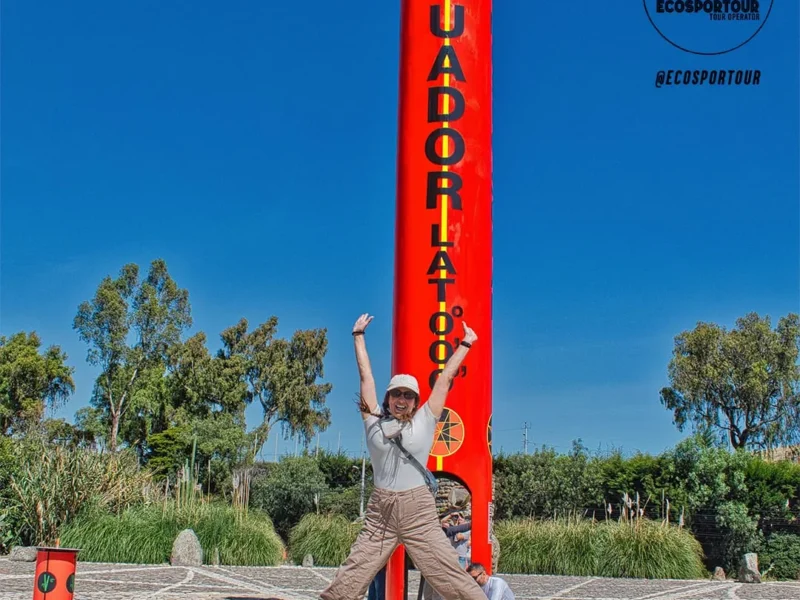
- Quitsato solar clock: the equator line, built to track the solstices and the equinoxes, running across the summit of Cayambe. The price does not cover the $5 ticket.
- San Pablo Lake viewpoint: the lake with Imbabura standing behind it.
- Plaza de los Ponchos, Otavalo: free time in the largest indigenous handicraft market in South America. Also, these are the two days when the fair is at its biggest.
- Cuicocha Lagoon: the crater, in the afternoon.
- Cotacachi: around 45 minutes in a town that lives from leather.
How much walking does Cuicocha really involve?
This is what decides whether you love the place or feel short-changed: there are two different ways to see it.
The first is the viewpoints. From the visitor area you walk out to the lookouts above the water. That is where the photograph of the two domes comes from. On our tour that is what the stop is: short walks at the rim in the afternoon. With six stops in one day the lagoon is a viewpoint visit, not a trek. So we would rather say so than have you turn up in boots expecting otherwise.
The second is the full rim trail, the loop that climbs and drops the whole way around the crater. It is a real hike above 3,000 m, exposed for long stretches, and it eats most of a day. It is not part of the Otavalo tour. So if a rim walk is your reason for coming north, tell us before you book.
What lives around the crater
The vegetation on the rim is high Andean, and from a moving car it all reads as scrub.
- Plants: spiky achupallas, mortino bushes, pumamaqui trees and small orchids in the damper folds.
- Birds: hummingbirds on the flowering shrubs, Andean gulls over the water and coots near the shore. Also, hawks ride the thermals off the crater wall.
- The water: the colour shifts with the light, from steel grey to a blue that looks edited in photographs.
When to go and what to bring
Across the whole day the route averages around 2,500 m and about 14C / 57F. However, the crater rim is the highest and most exposed point on it. Also, weather here changes by the hour rather than by the season. Cloud can close over Cotacachi and open again with no warning.
What we ask you to bring:
- Comfortable clothes and shoes
- Sunglasses
- A sun hat and sunscreen
- Your camera
The list is light because this is not a mountain day. Two things we would add. First, a thin windproof layer, because the rim is breezy at 3,068 m. Second, small cash for the extras below.
What is included and what you pay separately
The $56 covers your bilingual Spanish-English guide, authorised tourist transport and a menu-type lunch. It also covers the protected area entrance permits, which matter here precisely because Cuicocha sits inside a reserve. Not included: the $5 Quitsato ticket, extra meals and beverages, snacks and gratuities.
Boats do run on the lagoon from the dock below the viewpoints. However, the boats run separately from our day, and they are not part of the price. Also, whether they run depends on conditions at the reserve. Message us before you plan the afternoon around it.
Want more than a viewpoint up north?
Two of our acclimatization hikes look down on this landscape from above. Both run every day with a minimum of two participants, or privately for one.
- Fuya Fuya: summit at 4,290 m above the Mojanda Lakes, 17 km south of Otavalo. Also, expect views across to Cayambe, Imbabura and Cotacachi. Pick-up in Quito at 07:00 a.m., $130 per person, box lunch and certified bilingual guide included.
- Imbabura: around 5 hours up to the north summit at about 4,630 m from Casha Loma at 3,500 m. Then 3 hours 30 back down. Pick-up at 06:00 a.m., $130 per person, moderate.
See the crater for yourself
We have been operating in Ecuador for 15 years, and we run this day ourselves. That means our own bilingual Spanish-English guides and authorised transport. So what you read here is what you get, not a seat resold through three hands. Check the departure days and book on the Otavalo Cultural and Shopping page. Also, compare it with the rest of our tours. Or message us on WhatsApp at +593 98 094 2338 with your dates.