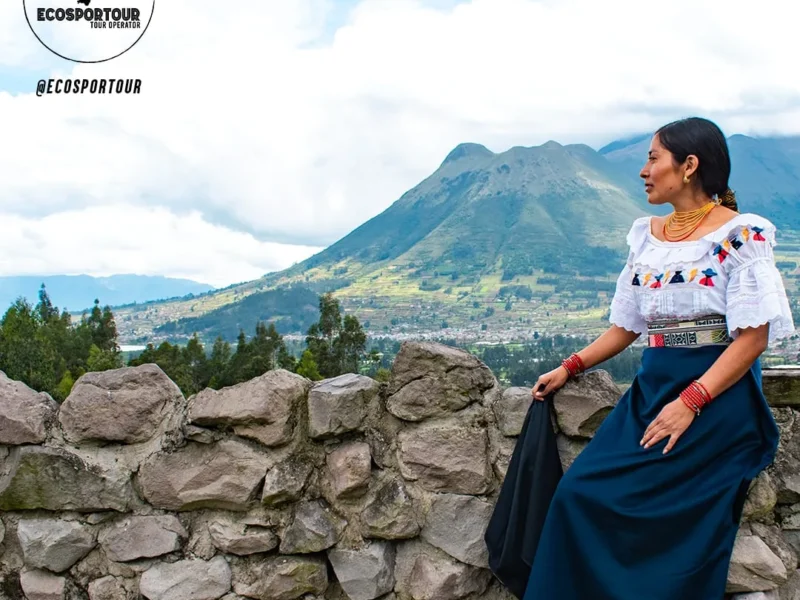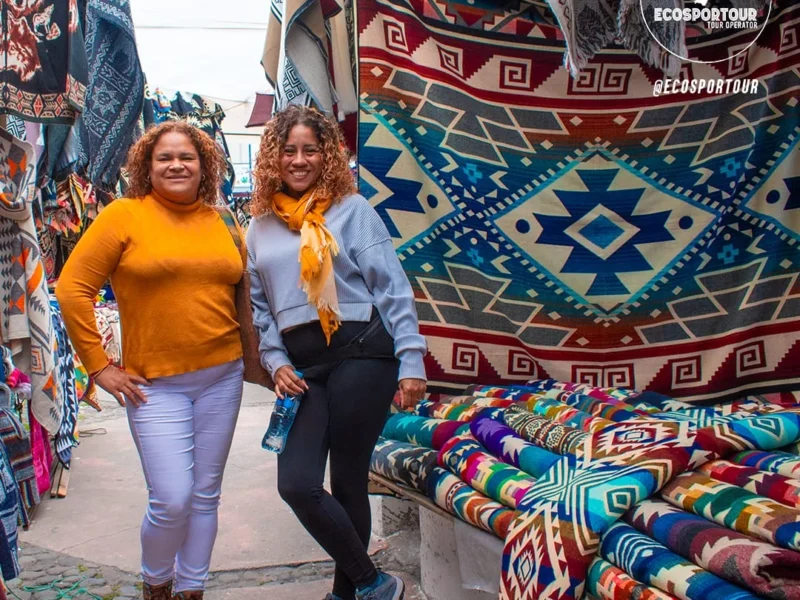
Otavalo sits about two hours north of Quito, in a valley closed in by Imbabura and Cotacachi. Most people arrive with one plan – buy a blanket – and leave wishing they had seen the rest: a crater lagoon with volcanic domes rising out of it, a town that lives from leather, and the equator line crossing a snow-capped summit.
If you have one day, the trick is not to spend all of it between the stalls. Here is what Otavalo in one day from Quito actually looks like: which day of the week to pick, the six stops that fit into twelve hours, and what it costs.
Which day of the week should you pick?
This matters more than anything else here. The Plaza de los Ponchos is the largest and most important indigenous handicraft market in South America, and it is not the same size every day of the week.
Our Otavalo Cultural and Shopping day runs on Tuesdays and Saturdays, and that is deliberate: those are the days of the biggest fair, when artisans from across the region come down to trade. If your dates in Quito are flexible, build the week around one of those two days. Turning up on a quiet weekday and finding a much smaller market is the most common Otavalo disappointment. The livestock market on the edge of town is a separate affair and not part of our route.
The six stops that fit into one day
The day is 12 hours, door to door. Pick-up is at Foch Square at 7:10 a.m. or at the Zular Coffee Shop on San Blas Square at 7:20 a.m., and the route runs like this:
- Bizcochos in Cayambe. The day opens with bizcochos straight out of the oven, with Ecuadorian coffee or hot chocolate. Cayambe is known across the country for them.
- The Quitsato solar clock. Built to track the solstices and the equinoxes, and known as the other middle of the world. The line you stand on runs across the summit of Cayambe. The $5 Quitsato ticket is the one entry you pay on the day.
- San Pablo Lake viewpoint. A stop above the lake with Imbabura standing behind it, the moment the geography of the valley makes sense.
- Plaza de los Ponchos. Free time in the market itself, on the main fair day. This is the centre of the day, not a photo stop.
- Cuicocha Lagoon, 3,068 m. An active volcanic crater in the afternoon, with domes emerging from the water.
- Cotacachi. Around 45 minutes in a town that makes its living from leather.
Lunch is a menu-type meal, and it is the only meal included.
How much time do you actually get to shop?
Two windows: free time in the Plaza de los Ponchos, which is the bulk of it, and around 45 minutes at the leather market in Cotacachi. Enough for a considered purchase, not enough to browse every stall. Before you walk in:
- Bring cash in small bills. Keep the $5 for the Quitsato ticket separate from your market money.
- Bargaining is normal, rudeness is not. A friendly counter-offer is part of the transaction. Grinding an artisan down over a dollar is not.
- Look at the back of the weave. Handwoven and machine-made sit side by side in the same square, and the reverse side tells you which is which.
- Cotacachi is for leather, not textiles. If you want a jacket or a bag, save some budget for the afternoon.
Cuicocha, the stop nobody plans for
Most people book this day for the market and come back talking about the lagoon. Cuicocha sits at 3,068 m inside a still-active volcanic crater, with forested domes pushing out of the water in the middle of it, and it lands in the afternoon. The walks here are short and easy – a viewpoint stop, not a hike – and the protected area permits are already covered, so there is nothing to pay at the gate.
What the day costs and what is included
The tour is $56 per person, shared, and it is rated easy: one out of five. That price covers a bilingual Spanish-English guide, authorised tourist transport, the menu-type lunch and the protected area entrance permits.
Budget separately for the $5 Quitsato ticket, extra meals and drinks, snacks and gratuities. What you spend in the market is the one part of the day with no ceiling.
What to wear and bring
Average temperature across the day is around 14C / 57F, at an average elevation of 2,500 m. Mild by highland standards, but the equatorial sun at this altitude is not. Pack:
- Comfortable clothes and shoes – there is walking, but all of it short and easy
- Sunglasses, a sun hat and sunscreen
- A camera
- Cash in small bills, plus a bag with room in it
If you would rather climb than shop
Two of the mountains around the valley are climbable in a day from Quito, with no glacier and no technical ground. Both cost $130, run every day with a minimum of two participants (private for one), and include return transport, a certified bilingual guide, a box lunch and technical equipment.
- Fuya Fuya – 4,290 m. The peak above the Mojanda lakes, 17 km south of Otavalo. Its name comes from the Kichwa word Fuyu, meaning cloud. Hotel pick-up at 07:00 a.m., and from the top you look down onto Mojanda Lagoon and across to Cayambe, Imbabura and Cotacachi.
- Imbabura – 4,630 m. The mountain that names the province and stands over Lake San Pablo. From Casha Loma at 3,500 m it is about 5 hours up to the north summit and 3 hours 30 back down. Pick-up at 06:00 a.m., because it is a long day on the mountain.
Both are classic warm-up days before Cotopaxi, Cayambe or Chimborazo. Still weighing the options? Our guide to the best day tours from Quito lays them out side by side.
Ready to spend a day in Otavalo?
We operate this day ourselves, with our own transport and our own bilingual guides, which is why we can tell you which two days of the week are worth your time instead of selling you a quiet Wednesday. Check dates and book on the Otavalo Cultural and Shopping page, compare it with the rest of our day tours from Quito or the full tour list, or send us a WhatsApp at +593 98 094 2338 and we will tell you straight whether Otavalo is the right use of your free day.