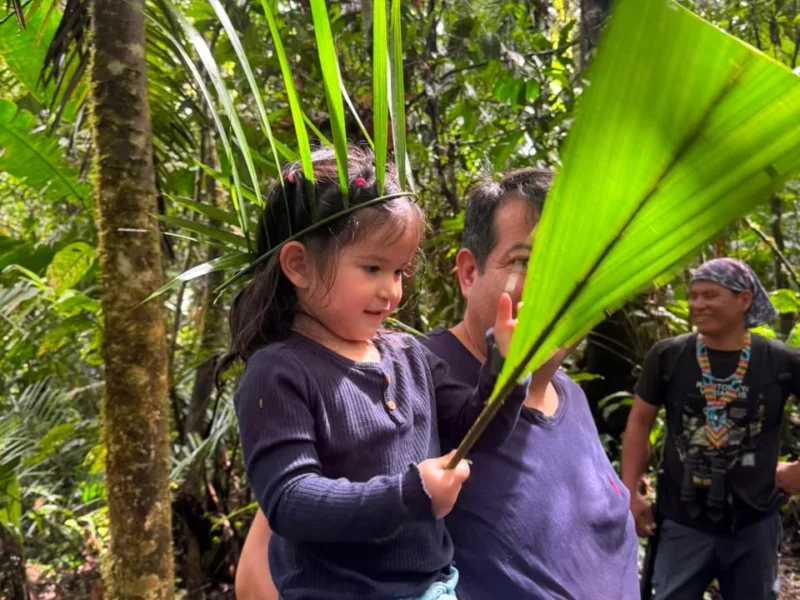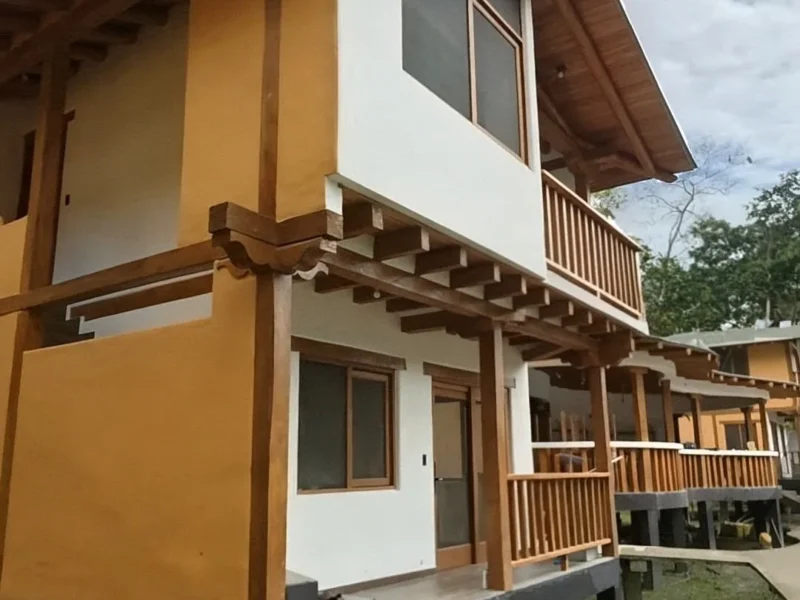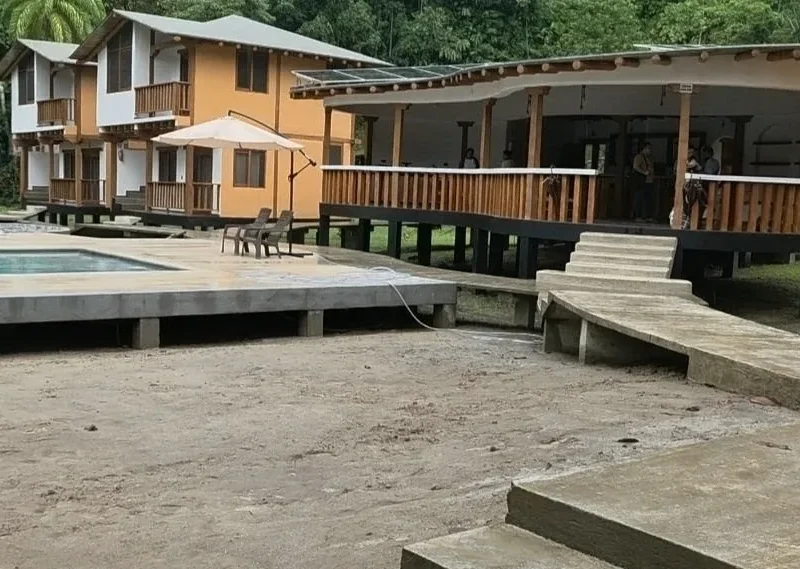
Tena sits where the Andes give up and the Amazon basin takes over. So jungle hiking in Tena is nothing like walking in the highlands. No altitude, no scree, no wind. Instead you get heat, humidity, mud and a very dense forest. In fact, the guide has to point at something three metres away before you see it. Our trails are around Tena Amazon Lodge, on the Arajuno River in Napo province.
This guide covers what jungle hiking in Tena actually involves. You will see which walks are on offer and how hard they are. Also, we explain why you should not buy hiking boots for it, and what the forest realistically shows you.
Where the trails start
Every walk described here happens around Tena Amazon Lodge. You meet us at the Arajuno River Bridge (Puente del Rio Arajuno) at 12:00. Then the last stretch is by water. You spend about twenty minutes in a motorised canoe, zigzagging upriver with tropical forest on both banks. The trails begin where the boat stops.
From there the walking spreads in three directions. First comes the forest immediately around the lodge, then the secondary-forest trails a little further out. Finally, river excursions reach the Pañayaku reserve, Caiman Island and the saladero. That last one is a natural clay lick, one of the few still preserved in the Ecuadorian Amazon.
The five walks, and what each one is for
- The interpretive hike: around an hour on the first afternoon, close to the lodge. Your guide explains the vegetation and how a tropical rainforest works. Also, it is on every programme and the gentlest walk of the trip.
- The night walk: after dinner on day one, built around sound rather than sight. Frogs and insects take over the forest and the pace is deliberately slow. This is the walk where you will regret not packing a torch.
- The dawn walk to the saladero: an early start before breakfast, when the jungle is at its quietest. You head out to the clay lick where parrots and parakeets gather. There they eat the mineral-rich clay that balances their diet.
- The three-hour forest hike: only on the four-day programme, on the afternoon of day three. Secondary forest trails with a local guide who explains medicinal plants, forest species and the ancestral uses of Amazonian flora.
- The sunrise lookout: four-day programme again. You walk before sunrise on the final morning to a natural lookout. Then you hear the jungle wake up before breakfast at 8:00 a.m.
How hard is jungle hiking in Tena?
Easier than most people expect, and considerably sweatier. The two-day and three-day programmes count as easy. The four-day one adds a morning on the water and that three-hour hike, and it carries a moderate rating. Nothing is technical and nothing is high. Instead, the difficulty here is heat, humidity and footing, not gradient or altitude.
Two practical consequences. Drink more than you think you need. The dining areas serve unlimited water, coffee and tea, included in the price. So fill your bottle before every walk. And wear the rubber boots we provide, because mud is the real terrain here.
Boots and clothing: what not to buy
We include rubber boots in EU sizes 34 to 45. If your feet fall outside that range, bring your own pair. That is the single most useful thing to know before you pack. Rain ponchos and life jackets come with the trip too, so there is no technical waterproof shell to buy.
What we do ask you to bring:
- Long-sleeved shirts, two or more: better than repellent for keeping insects off your arms.
- Comfortable trousers, two or more, and no jeans: wet denim on a humid trail is miserable and it never dries.
- Trainers and/or sandals: for the lodge, the canoe and the pool. The boots cover the trails, so your own shoes never meet the mud.
- Hat or cap, sunscreen and mosquito repellent: the river sections get full sun even when the forest does not.
- A small waterproof backpack and dry bags: for clothes, gear and documents. Everything travels by canoe at some point.
- A torch with spare batteries: for the night walk and the pre-dawn starts.
- Binoculars: optional, and the one worth the weight at the clay lick.
What you will actually see
We would rather say this plainly than have you arrive expecting a wildlife documentary. This part of the Amazon is above all about culture, landscape and connecting with the rainforest. Sightings do happen, especially birds at the saladero and around Pañayaku and Caiman Island. However, the season can limit them.
What never fails is the forest itself. For example, the plants your guide can name, and the medicinal uses still current in the communities on this river. Add the chorus of frogs and insects after dark, and the birds at first light. So set your expectations there and the walking delivers.
Which programme puts you on the trails most
- Discover the Amazon, 2 days: from $192 per person, rated easy, up to 15 travellers per guide. It brings the interpretive hike, the night walk and the dawn clay lick. Also, the Pañayaku reserve, Caiman Island and the Sharayaku Kichwa community come in depending on conditions.
- Explore the Amazon, 3 days: from $243 per person, rated easy. You get the same walking, plus a full afternoon in the San Bartolo Sharayaku community. On top of that, an artisanal chocolate workshop lets you dry, roast, grind and taste the cacao yourself.
- Adventure in the Amazon, 4 days: from $354 per person, rated moderate. This is the one to book if walking is the point. It adds the three-hour secondary-forest hike and the sunrise lookout. Then comes a morning of tubing, kayaking or paddling on the Arajuno.
All three depart any day of the week. Each one comes with a bilingual English and Spanish guide, full board and every canoe transfer. However, the price leaves out the journey from Quito to the Arajuno River Bridge. We can arrange a door-to-door transfer at extra cost, though. It also excludes the USD 10 per person entrance to the community and the Pañayaku reserve, subject to change.
Ready to walk into the Arajuno forest?
We are a local Ecuadorian operator, and we run these programmes ourselves. Our own guides work the river, and our own lodge waits at the end of the canoe ride. That is why we can be straight with you about what the forest will and will not show you. Check dates and book on the 4-day Arajuno River page. Then compare every Tena and Napo River programme, or browse the rest of our tours in Ecuador. You can also send us a WhatsApp at +593 98 094 2338. After that, we will tell you which one puts you on the trails most.