Galapagos is the rare place where the wildlife does not run away. Nothing here evolved with a land predator to fear. So a sea lion swims up to your mask, and a marine iguana keeps sunbathing while you step around it. Meanwhile, a blue-footed booby nests a metre from the marked trail.
Below is the Galapagos wildlife worth planning a trip around. Also, you will see where each animal lives and which programme puts you in front of it.
Giant tortoises, wild and in the breeding centres
The animal that gave the islands their name turns up in three different settings.
- Free in the highlands. The wet green interior of Santa Cruz, around El Chato. Island hopping routes starting at Baltra go up there on the afternoon of day 1, together with the lava tunnels.
- In a breeding centre. The Arnaldo Tupiza centre on Isabela, one of the best in the archipelago. It comes on day 3 of the Santa Cruz and Isabela route.
- At the Charles Darwin Research Station. Tortoises in captivity, the hatchling breeding centre, Lonesome George and the conservation exhibition. You visit on the land day of the San Cristobal, Española and Santa Cruz route. Also, the same station closes the four-day C route of the Hermes Catamaran.
Marine iguanas: the only sea-going lizard on earth
They feed on algae underwater, then pile onto black lava to warm up again. So you find them in heaps rather than alone. The dependable places on our routes are Tintoreras islet off Isabela and La Lobería on San Cristobal. On Tintoreras, a 45-minute walk crosses a nesting colony. Also Española, where the trail passes nesting females. On Española they turn red and green, which is why the cruises call the Suarez Point animals red marine iguanas.
Sea lions: the ones that come to you
Sea lions start the encounter, which is why they are the animal travellers end up talking about. La Lobería, on the first afternoon of the San Cristobal route, is the biggest colony on that island. There, you snorkel straight off the beach among reef sharks and turtles. Punta Carola, on the two routes that cross on day 3, is another large colony in warm, clear water. Meanwhile, the cruises add Gardner Bay on Española and Lobos Islet.
Boobies, frigatebirds and the waved albatross
The seabirds are not spread evenly, so the islands your route touches matter.
- Blue-footed boobies. On the short boat ride around Tintoreras and along the Española trail. Also at Suarez Point and Lobos Islet on the cruises.
- Red-footed boobies. Punta Pitt, on San Cristobal, visited on the 360 tour day of three of our island hopping routes.
- Masked boobies. Nesting on Española next to the blue-footed colonies.
- Frigatebirds. Both species nest above the bay at Tijeretas Hill. You reach it on day 1 of the four-day C route of the Hermes Catamaran.
- Waved albatross. Española only, and only from May to December, when the birds fly in from the mainland to nest. Outside those months the walk still gives you the iguanas and the boobies.
Hammerhead sharks, reef sharks and rays
Kicker Rock, or Leon Dormido, is the one people book for. It is the only site in Galapagos where you can snorkel with Galapagos hammerhead sharks. Also, it sits 40 minutes by yacht from Puerto Baquerizo Moreno. Sea turtles and sea lions are regulars there too, but nobody can guarantee sightings. Instead, white-tip reef sharks are far more predictable. They turn up at Pinzon, Tintoreras and the shallow lava tubes of Los Finados. Manta rays usually appear on the second snorkel at Santa Fe. Then Rosa Blanca Bay closes the 360 tour: a lava-pool swim with Galapagos sharks, sea lions and turtles.
Galapagos penguins and the flamingos of Isabela
The Galapagos penguin is the only penguin that lives north of the equator, and Isabela is where you meet it. The Santa Cruz and Isabela programme looks for them on the boat ride out from Tintoreras. Then it swims with them at Los Tuneles, a maze of lava islets calm enough for children.
Flamingos are on the same island. Isabela’s wetlands are a brackish lagoon holding the biggest flamingo population in Galapagos. Also, the walk there follows the afternoon at the tortoise breeding centre. Meanwhile, the cruises reach a second flamingo lagoon at Cormorant Point on Floreana, beside the green-sand beach.
Sea turtles, seahorses and Darwin’s finches
Turtles are in the water on almost every snorkel. However, two beaches are nesting sites with a calendar. First, La Fe, reached by yacht on day 2 from Puerto Ayora, takes nesting females between November and February. Second, Las Bachas, on the Bonita Yacht five-day B route, is a green turtle nesting beach too. Seahorses are the surprise, living in the shallow volcanic tubes of Los Finados off Isabela. Darwin’s finches feed in the endemic vegetation around Los Gemelos, the two volcanic sinkholes visited on the way to Baltra airport.
Which route sees what
- Penguins, flamingos and seahorses: the Santa Cruz and Isabela 5-day route, rated easy, four nights on land.
- Hammerheads and red-footed boobies: the Santa Cruz and San Cristobal 5-day route, also easy, built around boat days and snorkelling.
- The waved albatross: the two six-day routes, rated moderate. Española is a two-hour walk over uneven volcanic ground, plus two hours of sailing each way. Then choose between flying into Baltra and flying into San Cristobal.
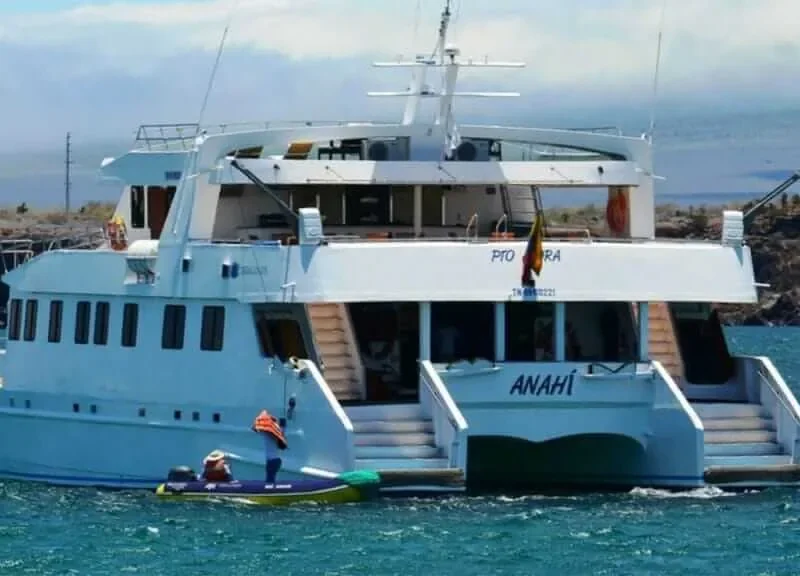
- Floreana, Genovesa and the outer islands: by cruise only. Post Office Bay and Devil’s Crown are on the Aida Maria. The Nemo II gives a full day on Genovesa at Darwin Bay and El Barranco. Also, you find the rest on the Galapagos cruises page.
On the island hopping programmes, departures run daily. Also, every yacht excursion includes snorkelling equipment, towels and a bilingual naturalist guide licensed by the National Park. The rates do not cover flights. Meanwhile, you pay the USD 200 National Park entrance fee and the USD 20 Transit Control Card on arrival.
Plan your Galapagos wildlife trip
Ecosportour is an Ecuadorian operator with 15 years in the country, and you book these programmes with us directly. So the person answering your questions is the one putting your route together. If you want tortoises, penguins and flamingos in one week, start with the Santa Cruz and Isabela island hopping. Instead, if the albatross is what you came for, look at the six-day route through Española. Compare every option on our tours page. Or send a WhatsApp to +593 98 094 2338 and tell us which animal you refuse to miss.