Ask when to visit Galapagos and the honest answer is that there is no closed season. The archipelago sits on the equator, the national park stays open all year and boats sail every week. So the real question is not when the rules let you go. It is what each half of the year gives you, and what it takes away.
Two ocean currents decide most of it. Here is what changes between the two halves, which wildlife dates never move, and which weeks cost more. Then we get to why a boat and a hotel answer the question differently.
The warm season: December to May
From around December to May the archipelago runs warm and wet: hotter air, warmer sea, calmer crossings. Rain arrives as short heavy showers and clears within the hour. The lowlands turn green and long snorkels are comfortable without much neoprene.
This is the kinder half of the year for anyone who is nervous about boats. Every Galapagos programme involves open water. Our 5-day Santa Cruz and San Cristobal route, for example, crosses two hours by speedboat. Espanola sits two hours each way. Those hours are gentler in the warm months.
The cool season: June to November
From around June the Humboldt current pushes north and everything cools down. Mornings arrive with garua, the fine grey highland mist. The sea gets choppier, and the water turns cold enough to feel on the second snorkel of the day. It also gets richer: that cold water carries the nutrients the whole food chain feeds on. As a result, the islands feel busier below the surface than above it.
That is why our Eden yacht puts wetsuits in the rate instead of on the rental desk. When the Humboldt is running, a wetsuit makes the difference. It separates a ten-minute swim from an hour in the water with sea lions and turtles.
When to visit Galapagos for wildlife: the two fixed dates
Most Galapagos wildlife does not go anywhere. Sea lions, marine iguanas and boobies are there in every month. So are the giant tortoises of the Santa Cruz highlands and the hammerheads at Kicker Rock. However, no sighting ever comes with a guarantee. Two things are seasonal:
- Waved albatross, May to December. Espanola is the only nesting ground on earth for the species. Those are the months the birds are on it. That full day on the island sits inside our 6-day Santa Cruz, San Cristobal and Espanola route. Outside the season the same two-hour walk still passes nesting marine iguanas and booby colonies.
- Sea turtle nesting, November to February. Females come ashore to lay their eggs at La Fe beach. That white-sand stop sits on day 2 of our 5-day Santa Cruz and Isabela programme.
The weeks that cost more
Demand, not weather, moves Galapagos prices, and the boats publish their surcharges openly. It is the clearest map of the busy weeks there is:
- Late December to early January. The Grand Daphne adds 5 per cent from 18 December to 5 January. The La Pinta adds $290 per adult and $175 per child. Those surcharges run from 20 to 26 December and from 30 December to 3 January. The Nemo II adds 10 per cent, the Hermes 5 per cent.
- Late March to early April. The other high-season window on the Grand Daphne runs from 27 March to 7 April.
- Easter. The Tip Top IV applies a 20 per cent surcharge on Easter, Christmas and New Year departures.
Move a week either side of those windows and the same cabin costs less.
Cruise or island hopping? The calendar behaves differently
On a cruise you do not choose a date, you choose a departure day. Each boat sails a fixed weekly cycle. The Grand Daphne, for example, leaves on Wednesdays for its 4-day B route and both 8-day routes. On Saturdays it leaves for the 5-day B. The Eden goes on Thursdays, Sundays or Tuesdays depending on the itinerary. Your flights have to fit that grid, and in the busy weeks the good cabins go first.
Our four island hopping programmes work the other way round, with daily departures. You sleep on land in a hotel with air conditioning and a private bathroom. Then a yacht excursion goes out every morning. If your travel dates cannot move, land-based is usually the answer.
What to pack, whichever month you choose
The list barely changes across the year; what changes is how badly you want the wetsuit. From the kit we ask island hopping guests to bring:
- Swimwear and a quick-dry change of clothes.
- Reef-safe sunscreen, a hat and sunglasses. The equatorial sun is fierce even under garua cloud.
- A windbreaker. You will want it for the crossings, wet and windy in any season.
- Shoes or sandals with grip for the lava trails. Also cash in US dollars, because none of the four programmes includes dinners. On the Isabela route it matters more: that island has no ATMs.
- Your passport. The Galapagos Governing Council issues the Transit Control Card against it.
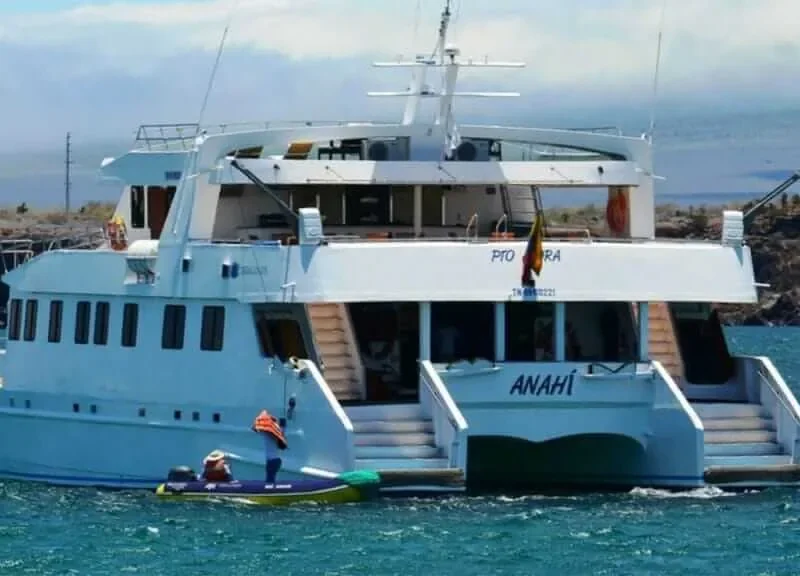
On wetsuits the boats differ, and it matters most from June to November. The Eden, the Bonita, the Monserrat I and the Hermes include them in the rate. La Pinta includes the rental. On the Nemo II they are $5 per person per day. On the Grand Daphne, $20 per person for a 4-day cruise. The Anahi does not include them at all, so bring your own.
The fees that do not change with the season
Whatever month you sail, you make two payments on arrival that sit outside the tour price on almost every boat. First comes the Galapagos National Park entrance fee of $200. Then the $20 Transit Control Card, issued by the Galapagos Governing Council. The one boat in our fleet that carries both inside the rate is the Hermes catamaran. The flight to and from the islands is usually separate too. The exception is the Tip Top IV, whose rate generally already includes the Quito or Guayaquil to Galapagos flight. If you buy your own flight instead, the rate drops by $350 per person.
Tell us your month and we will find the boat
We are an Ecuadorian operator based in Quito. We run the island hopping programmes end to end with our own team. Our bilingual naturalist guides hold Galapagos National Park licences. So if you are still weighing when to visit Galapagos, talk to us. We can tell you which departure days remain open in your month. We can also say whether the extra day on Espanola is worth it. Start with the 6-day Espanola route, or compare the rest of our Galapagos cruises and tours. You can also send us a WhatsApp at +593 98 094 2338 with your dates, and we will check availability.