The Galapagos are the one part of Ecuador you cannot improvise. There is no ferry from the mainland. Instead, you fly in from Quito or Guayaquil and pay two compulsory fees at the airport. Also, almost the whole archipelago is national park, so every visitor site needs a licensed naturalist guide. The upside is that there are only a handful of real decisions, all made before you leave home.
This Galapagos travel guide walks through them using our own programmes as the reference. First, which airport to fly into and what you pay on arrival. Then cruise or island hopping, how many days you need and what to pack.
Getting there: two airports and the open-jaw ticket
Galapagos has two arrival airports: Baltra (GPS), which serves Santa Cruz, and San Cristobal (SCY). The programme decides which one you use. Also, several of ours fly you in through one and out through the other. So you need an open-jaw ticket rather than a return.
- In and out of Baltra: Santa Cruz and Isabela, 5 days. It picks you up at Baltra at 11:00 on day 1 and ends there on day 5.
- In Baltra, out San Cristobal: the Santa Cruz and San Cristobal 5-day route and the six-day version with Espanola.
- In San Cristobal, out Baltra: the six-day San Cristobal, Espanola and Santa Cruz route reverses the whole thing.
- Cruises: the Aida Maria 4-day and La Pinta start at Baltra. The Archipel I 4-day A4 route starts at San Cristobal instead. Meanwhile, the Treasure of Galapagos leaves Baltra except on its 5-day B route.
No programme includes the flight, and which airport you fly into decides how the ticket has to be built. On the cruises, booking it with us keeps the airport assistance in Quito or Guayaquil. In fact, the Archipel I and the Treasure both state that you lose it if you ticket yourself.
What you pay on arrival
Every visitor pays two compulsory charges and no rate includes them: the Galapagos National Park entrance fee, USD 200 per person (USD 30 for Ecuadorian nationals), and the Transit Control Card, USD 20 per person, issued by the Galapagos Governing Council and subject to change. Carry your passport, because the card is issued against it.
Some routes add their own extras, and cash matters more than people expect: Isabela has no ATMs. We break all of that down, fee by fee and route by route, in how to get to Galapagos from Quito.
Cruise or island hopping?
This is less about budget than about where you sleep.
Island hopping means sleeping on land. On our five and six-day programmes you get a hotel of your choice with air conditioning and a private bathroom. You also get breakfast at the hotel and lunch at local restaurants from day 1 to the last morning. On top of that, yacht excursions come with a naturalist guide licensed by the Galapagos National Park. The price also covers snorkel gear and towels. So do hotel taxes, water taxis, the Itabaca Channel crossing and exclusive airport transfers. Dinners are not covered, which is how you end up eating where the islanders do.
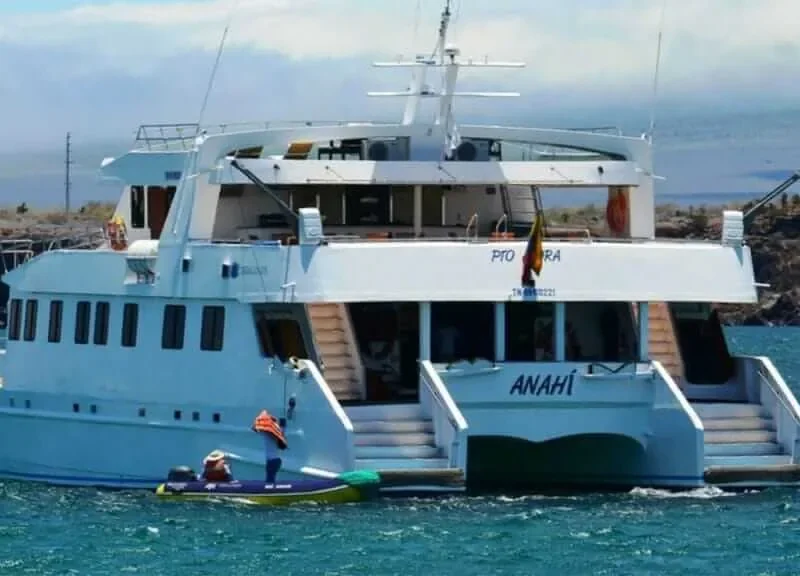
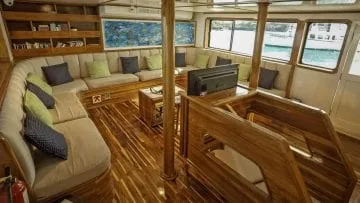
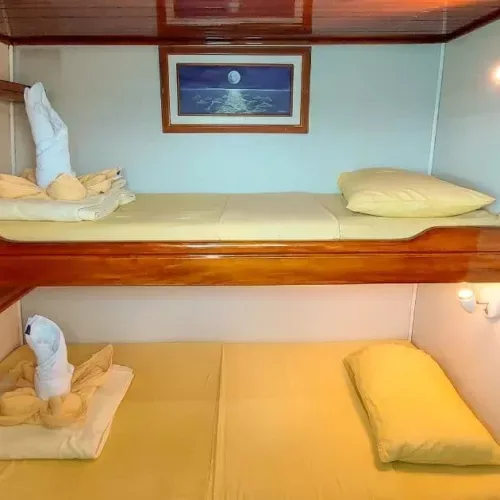
A cruise means sleeping on board and waking up somewhere new. The rate covers every meal from lunch on day 1 to breakfast on the final day. Cabins have private bathrooms. Also, the boat moves overnight, which is the only way to reach the outer islands. Fernandina and western Isabela are cruise territory. For example, the 7-day Treasure of Galapagos itinerary leaves Baltra on Saturdays. It reaches Tagus Cove, Espinoza Point and the Wall of Tears.
Check the snorkel gear boat by boat. The Archipel I, the Treasure and La Pinta include it. The Aida Maria instead rents it at USD 5 per person per day, wetsuits at USD 10.
How many days, and how demanding is it?
Five days is the comfortable minimum. Four is short, since the first and last days are largely airports. Meanwhile, six buys a full day on an outer island.
- 5 days / 4 nights on land: Santa Cruz and Isabela, or Santa Cruz and San Cristobal. Both rated easy.
- 6 days / 5 nights on land: the same backbone plus a full day on Espanola. Both rated moderate.
- 4 or 5 days by catamaran: the Archipel I runs four routes. The 4-day pair departs Mondays, and the 5-day pair departs Thursdays.
- 4 to 15 days: the Aida Maria has seven itineraries, if you want two weeks at sea.
Fitness is rarely the limiting factor: the easy programmes are boat trips, snorkelling and short walks. The six-day ones carry a moderate rating because of Espanola. That day means two hours of sailing each way and a two-hour walk over uneven volcanic terrain. What tires people is the crossings and the alarm clock. For example, the two-hour ferry from Puerto Ayora to San Cristobal leaves after a 06:00 pick-up.
When to go, and what you will see
There is no bad month, but several sightings are seasonal. The waved albatross nests on Espanola between May and December. Outside those months, the same walk still passes nesting marine iguanas and blue-footed and masked booby colonies. Sea turtles come ashore to lay at La Fe beach from November to February. Kicker Rock, on the San Cristobal routes, is the only Galapagos site where snorkellers can swim with Galapagos hammerhead sharks. Los Tuneles at Cabo Rosa, off Isabela, is shallow, very calm water. There, you swim with Galapagos penguins and sea lions among lava islets. So it suits children. As with all wildlife, there are no guarantees.
What to pack
- Swimwear and a quick-dry change of clothes. You will be wet most days.
- Reef-safe sunscreen, a hat and sunglasses. You are on the equator, mostly on water.
- A windbreaker. The speedboat crossings are the cold part of the day.
- Trainers or sandals with grip for the lava trails, plus closed walking shoes for Espanola.
- Binoculars and a camera for the albatross and booby colonies.
- Cash in US dollars and your passport.
Plan your Galapagos trip with the operator
We are a Quito operator with fifteen years of running trips in Ecuador. So you deal directly with the people who built the programme. Compare the land routes on our island hopping page. Then look through the boats on the Galapagos cruises page, or go straight to La Pinta. You can also browse the rest of our tours. Better yet, send us a WhatsApp at +593 98 094 2338 with your dates. Then we will tell you which airport pairing and which boat fit them.