Quito’s Old Town is the reason to stop in the capital instead of driving straight out to a volcano. It went onto the very first UNESCO World Heritage list in 1978. Also, it remains one of the largest and least altered colonial centres in the Americas. It is also a working neighbourhood, not an open-air museum. Think schoolchildren cutting across the main square, shoeshiners under the arcades, bells at seven in the morning.
The good news for a short trip: the essentials sit inside roughly one square kilometre. Everything lies at 2,850 m above sea level. Close enough to walk, high enough that the uphill blocks will surprise you. Here is what earns your time.
Start at the Basilica del Voto Nacional
The neo-Gothic Basilica is the tallest church in Ecuador and the easiest landmark to navigate by. Look up before you go in: instead of European gargoyles, the stonemasons carved Ecuadorian animals – tortoises, iguanas, armadillos, condors. Building started in 1892, and nobody has ever formally finished it. So the locals joke that the world will end on the day someone does. Climbing the towers is the part people remember: a plank walkway above the nave, then ladders in the open air.
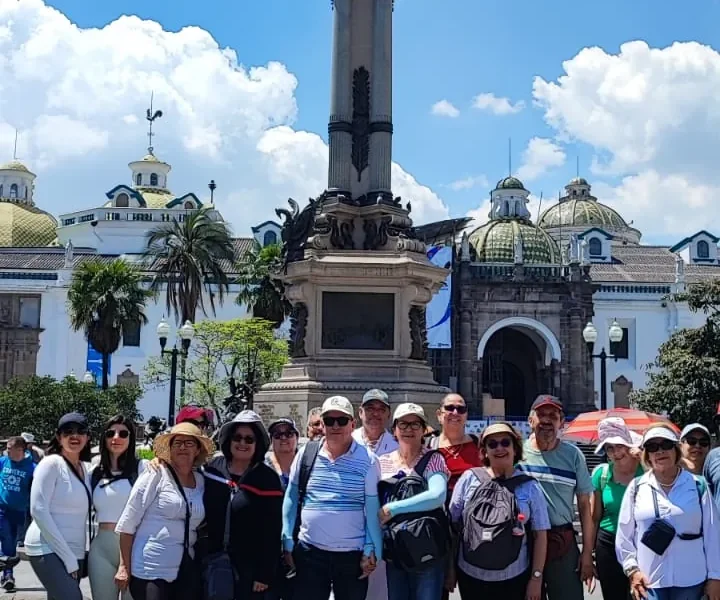
This is also where our Half Day Walking Tour Quito meets, at 10:00 a.m. or 2:00 p.m., every day of the week. Our office is on the corner by the Basilica, at Venezuela N11-99 y Carchi. So you can walk in and ask before you book. The route covers the facades of the main colonial churches. It adds the squares where the city’s history happened and the legends locals still tell. Then it finishes with traditional sweets and Ecuadorian chocolate at Yumbos Coffee Shop.
Plaza Grande and the buildings around it
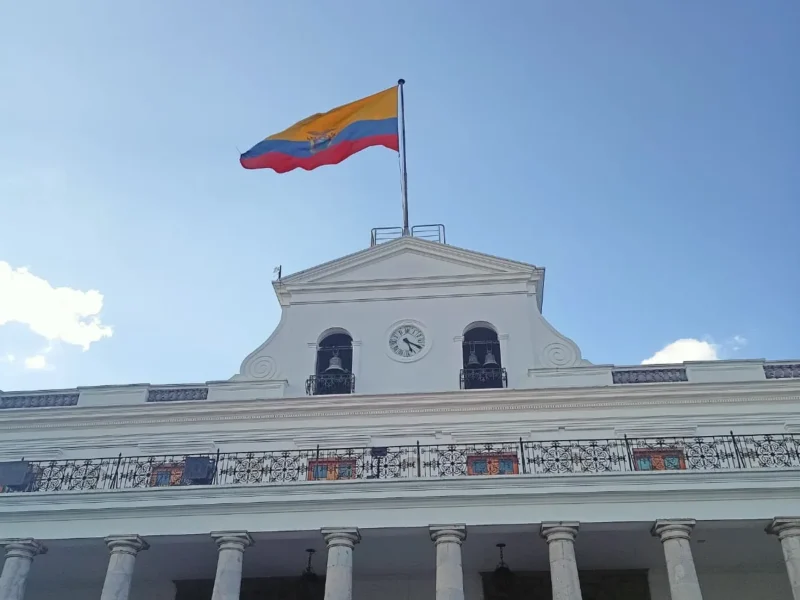
Plaza de la Independencia, which nobody calls that, is the centre of gravity of the Old Town. Around it stand the Carondelet Palace and its guards, the Cathedral and the Municipal Palace. Also there: the Archbishop’s Palace, now a courtyard of shops and cafes. Sit on a bench for twenty minutes and you learn more about Quito than in any museum. There is a changing of the guard on Mondays; times shift, so ask your guide that morning. From the plaza, walk down Garcia Moreno, the Street of the Seven Crosses.
Which churches are worth paying to enter?
Each interior charges its own ticket, and you cannot do them all properly in one visit. If you have appetite for two, make them these.
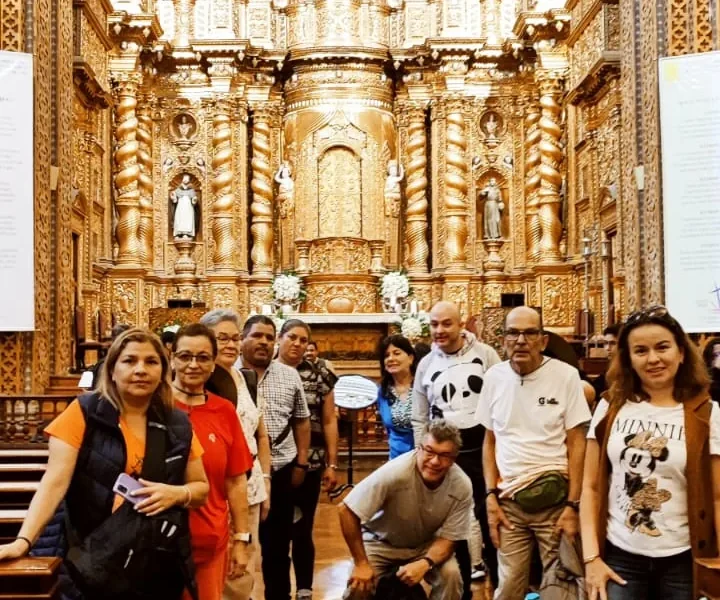
- La Compania de Jesus. The one visitors talk about years later: more than 160 years in the building. It shows a volcanic stone facade of twisted columns and an interior finished almost entirely in gold leaf. The church restricts photography inside.
- San Francisco. Begun in 1535, and still the largest colonial complex in the Americas. Its sloping cobbled plaza is the best place in town to watch the light change. Also ask about Cantuna, who in the legend hired the devil to build the atrium. He then hid one stone so the work would never be complete.
- Santo Domingo. Quieter, at the far end of the historic centre. Most people cross its plaza on their way elsewhere, but a painted ceiling waits for those who stop.
Our walking tour does not include entrance fees to churches and museums. It covers neither food and drinks nor tips. That is deliberate. The guided route works the facades, the squares and the stories, and you choose which interiors deserve a ticket.
La Ronda, and where the evening goes
Calle Juan de Dios Morales, which everybody calls La Ronda, is a narrow cobbled lane of restored houses. The balconies almost touch overhead. By day there are workshops: hats, toys, candied fruit. In the evening it fills up, and the drink to order is a canelazo, hot cane spirit with cinnamon and naranjilla.
The two views worth going up for
El Panecillo is the loaf-shaped hill at the southern edge of the Old Town. It carries a winged Virgin assembled from thousands of aluminium pieces. The view over the tiled roofs, with the volcanoes behind them on a clear morning, is the picture you came for. Take a taxi up rather than the stairs on the north face.
The other is the cable car on the western side of the city, which lifts you to 3,945 m. From that top station our Rucu Pichincha Acclimatization Hike carries on up on foot to the summit at 4,698 m. It leaves our agency in the historic centre at 08:30 a.m., every day. The minimum is two participants, but a single traveller can go as a private excursion. Also, the cable car ticket is not part of the price. If a bigger mountain is on your list, this is your acclimatization day.
What to know before you set off
- Altitude: Quito sits at 2,850 m. Walk slower than feels natural on your first day and drink more water than usual.
- Shoes: the streets are cobbled, uneven and steeper than any map suggests.
- Sun: you are on the equator at nearly 3,000 m. It burns even when the air is cold, and the weather turns by the hour.
- Cash: small dollar bills for church entrances, sweets and taxis.
- After dark: stay on lit, busy streets and take a taxi rather than crossing the centre on foot late.
How the Old Town fits into the rest of your trip
Three hours on foot from 10:00 a.m. leaves your afternoon open. Meanwhile, the 2:00 p.m. departure works well on the day you land. A day in the capital is not lost time before the mountains either: 2,850 m is where your body starts adapting.
- Cotopaxi Hike and Bike: 10 hours, Wednesday, Friday, Saturday and Sunday, from $61, pick-up at Foch Square at 7:10 a.m.
- Quilotoa Culture and Hike: 12 hours, Tuesday, Thursday and Sunday, from $56, same pick-up points and time.
The whole list is on our day tours from Quito page.
Walk the Old Town with a local guide
We have been operating out of Quito for fifteen years with our own guides. Also, our office sits inside the historic centre itself, on the corner by the Basilica. So this is the one walk we run on our own doorstep. It costs $13 per person for three hours, rated easy and guided in English and Spanish. Departures run every day at 10:00 a.m. and 2:00 p.m. Book on the Half Day Walking Tour Quito page, or browse the rest of our tours from Quito. Then send us a WhatsApp at +593 98 094 2338, and we will tell you which departure fits.