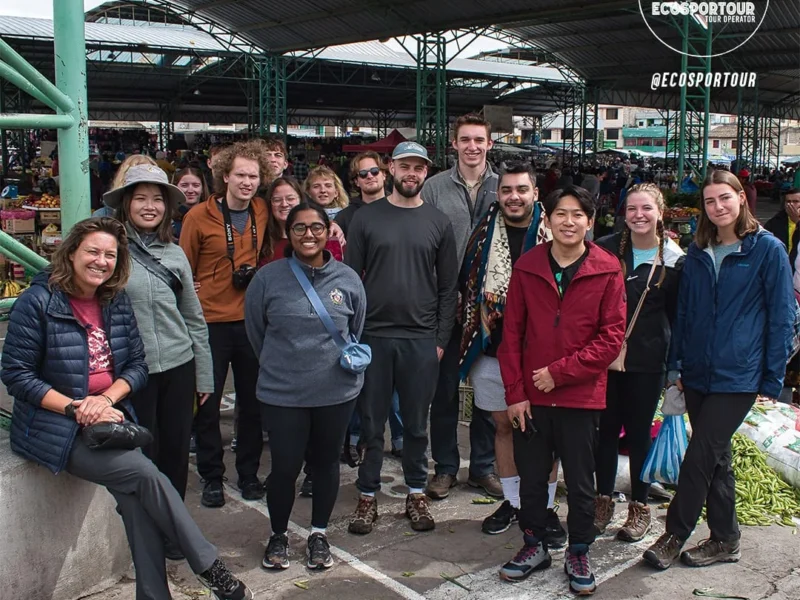
Quilotoa is a volcanic crater filled with emerald water, and the honest difficulty with any Quilotoa packing list is that a single day covers several climates. Our Quilotoa Culture and Hike leaves Quito at 7:10 a.m. and returns twelve hours later. In between you stand on an exposed rim at 3,900 m, walk down inside the crater and back up, browse a working Andean market and spend hours crossing the highlands by road.
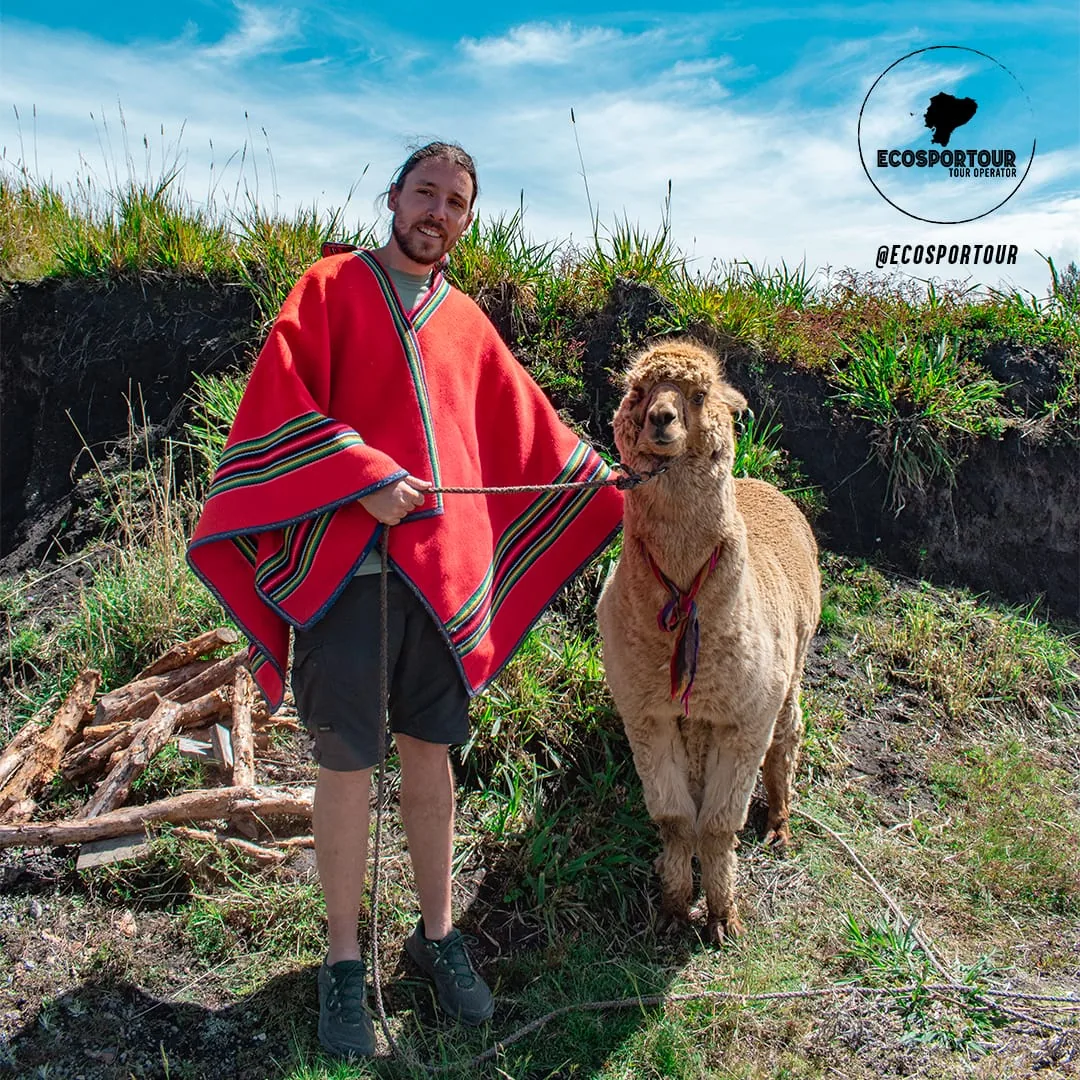
Below is the Quilotoa packing list we give our own passengers, the reason behind each item, and the exact amount of cash you should have in your pocket before you leave Foch Square.
How cold does it actually get?
Average temperature on this tour is around 12C / 54F, at an average elevation of 3,800 m. On its own that figure misleads. Twelve degrees in still sunshine at the market feels mild; the same twelve degrees on the crater rim, with wind off the water, does not. And then the climb back out of the crater will have you sweating in the cold. You are dressing for three situations, not one, so the answer is layers rather than one heavy coat.
What to wear at Quilotoa: the clothing list
This is the clothing list from the tour itself, with the reasoning added:
- Comfortable, warm clothes. Layers you can open and close. The vehicle is warm, the rim is not, and the walk back up generates surprising heat.
- A windproof jacket. The most useful single item of the day. Wind is what makes the viewpoint uncomfortable, not the temperature on the thermometer.
- Gloves, plus neck and ear protection. Easy to skip and easy to regret. Hands and ears are what get cold first at 3,900 m.
- Comfortable shoes for mountainous and sandy terrain. The path into the crater is loose volcanic ground, not a staircase. Grip matters most, and you will finish the day with dust inside your shoes whatever you wear.
- A sun hat and sunglasses. The glare comes off the lagoon as well as out of the sky.
Quilotoa packing list: what goes in the daypack
- Sunscreen. Non-negotiable. Cold air at altitude hides how strong the sun is, and the burn shows up hours after the damage is done.
- Water. Extra drinks are not included, so buy what you want to drink before you leave Quito.
- Snacks. Lunch is included, but it comes after the hike. Snacks are not included, so if you know you get hungry mid-morning, bring them.
- A camera. On the tour’s own kit list, and the reason is the crater viewpoint at 3,900 m.
- Cash in small bills. Enough of it that the next section is worth reading twice.
- A small backpack. You want both hands free on the way back up.
How much cash should you carry?
This is what travellers most often get wrong. The tour covers a great deal, but not the tickets at the stops. Carry:
- $2 per person. Quilotoa Lagoon entrance. Not included in the tour price.
- $1 per person. Toachi Canyon viewpoint, the stop above the river on the way to the lagoon. Not included either.
- $3 per person. Kayak on the lagoon, optional, and one of the highest places you will ever paddle.
- $10 per person. A horse for the climb from the shore back up to the rim, optional, and worth deciding before you start walking down.
So $3 is the strict minimum and $16 covers every optional extra. Add whatever you want for snacks, extra drinks, gratuities and anything you buy at the market or from the Tigua painters. Small bills are far easier to hand over than large ones, so sort that out in Quito rather than on the rim.
What you can leave off the Quilotoa list
Included in the $56 per person: a bilingual Spanish-English guide, authorized tourist transportation, a menu-type lunch and the protected area entrance permits. You do not need a packed lunch, and no ticket money for the permits themselves.
You do not need technical equipment either. The hike is rated moderate, three out of five, and it is around three hours in total from the viewpoint at 3,900 m down to the shore of the lagoon and back up to the rim. No rope, no crampons, no previous experience. Walking poles are a personal preference, not a requirement.
Pack for the market, not only for the crater
The day does not begin at the lagoon. It opens at a market that exists for trade rather than for visitors, where produce from the tropical lowlands is exchanged for produce from the highlands, and which one you see depends on the day: Saquisili on Thursdays, Pujili on Sundays. After it comes Tigua, whose painters work on stretched sheepskin and whose wood carvers are known well beyond Ecuador.
Practically: keep small change where you can reach it, and leave room in the bag if you intend to carry a painting or a carving home.
If you are doing the two-day version
Our Cotopaxi + Quilotoa 2 Days 1 Night puts the Jose Rivas refuge at 4,800 m into day one, colder and windier than anything Quilotoa will do to you, plus an optional bike descent to the Limpiopungo Lagoon at 3,850 m. Take the warmest gloves you own.
For the overnight, one night in a tourist-class hotel near Cotopaxi is included and you are collected there at 8:30 a.m. on day two, so a small overnight bag is plenty. Two lunches and breakfast on the second day are included; breakfast on day one and dinner are not, and the same $2 and $1 tickets apply at Quilotoa and Toachi. It runs Tuesday, Wednesday, Thursday and Saturday, from $152 per person, and it is confirmed from a single passenger. If you would rather keep the volcano and the crater on separate days, the Cotopaxi Hike and Bike is the one-day version of that first day.
Ready to walk down into the crater?
We operate this tour ourselves, with our own guides and our own transport, which is why the Quilotoa packing list above is the same one we give people over the phone rather than a generic one. The Quilotoa Culture and Hike runs Tuesday, Thursday and Sunday, twelve hours, $56 per person, with pick-up at Foch Square at 7:10 a.m. or at Zular Coffee Shop on San Blas Square at 7:20 a.m. Check dates on the Quilotoa Culture and Hike page, compare it with the rest of our tours from Quito, or send us a WhatsApp at +593 98 094 2338 and we will tell you what to expect on the date you are travelling.