Cuyabeno wildlife does not work like a zoo, and nobody can hand you a checklist. What the reserve gives you is a system of blackwater lagoons and flooded forest where the animals go about their lives, plus a guide who knows where to point the torch. Some of it you will certainly see. Some you will only hear.
Stand still on a trail here for ten minutes and you will hear more species than you can name: insects in three registers, a bird you cannot place, something heavy shifting in the canopy overhead. This guide explains why the Cuyabeno Wildlife Reserve holds so much life, then goes animal by animal. For each one: where it shows up, the excursion that puts you in front of it, and your realistic odds.
Why there is so much Cuyabeno wildlife in the first place
It comes down to three things: where the reserve sits, how the water changes shape through the year, and how the forest is built in layers.
Start with the equator. Cuyabeno lies in the upper Amazon basin, close enough to the line that days run about twelve hours all year. There is no winter and no dormant season, so the forest keeps producing leaves, fruit and flowers without a break. A temperate forest runs on a schedule everything has to survive; this one does not. That lets highly specialised feeders get through the year without a backup plan, and specialisation is what produces long species lists.
Then there are the mountains. Ecuador compresses a continent’s worth of altitude into a short distance, and the eastern slope falls from snowline to lowland rainforest in hours. So the rivers reaching the reserve carry down what they collected: sediment, minerals, seeds and species that spilled off the foothills. The western edge of the basin, pressed against the Andes, is its richest section, and Cuyabeno sits inside it.
Water is the engine, not the scenery
Cuyabeno is a water reserve before it is a forest reserve. Rivers, lagoons and flooded forest make up the map, and the map is not fixed. The level rises and falls with the rains, so ground you walk across in one season is water you paddle over in another. Trees stand submerged for months, and animals with fins handle some of the seed dispersal.
That flood cycle is a biodiversity engine. It builds a habitat that exists only part of the year, with its own residents, and it recharges the lagoons. Their dark, tannin-stained water is acidic and poor in nutrients, so it holds different fish and plants than the sediment-heavy rivers a short paddle away.
In practice, the only sensible way to be inside the flooded forest is to float through it. A whole afternoon of the 5-day Amazon expedition goes to exactly that.
The forest is stacked in layers, and so is the wildlife
A rainforest is not one habitat but four or five stacked vertically, and most of them are above your head. Emergent trees break through the roof and take the sun. The canopy underneath holds most of the fruit, the birds and the monkeys. The understory is a dim tangle of saplings and lianas, and the floor is a recycling plant where leaf litter vanishes.
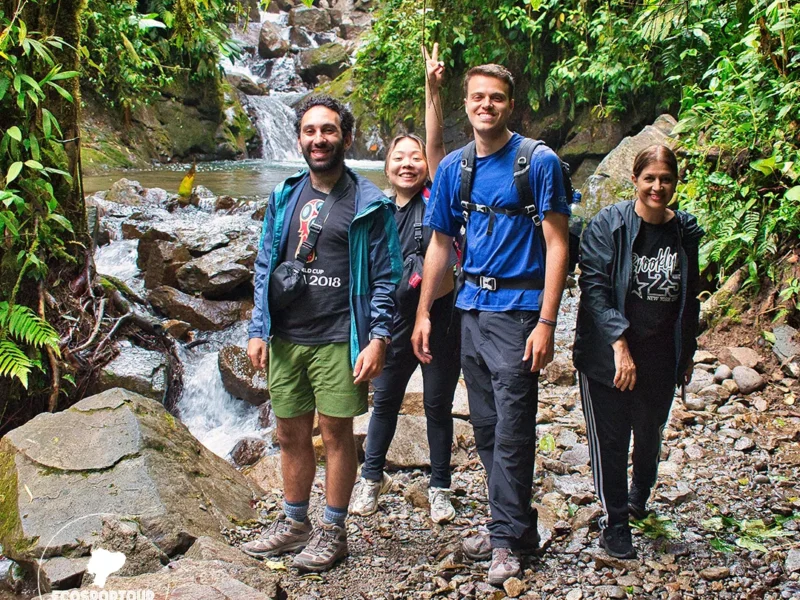
An animal adapted to one layer may never visit the others. That is how a small patch of ground holds so much, and it is why the guide matters. On the three-hour hike through primary forest, your bilingual naturalist guide, working in English and Spanish, stops at medicinal plants, frogs, insects and the details you would walk straight past alone. Leafcutter ants cross the trail in a green procession, a tree frog the size of a thumbnail appears, then a tarantula at the mouth of its hole.
Pink river dolphins
The bufeo, the Amazon river dolphin, is the animal our lodge is named after: Cuyabeno Dolphin Lodge. It never sees the sea, it has no tall fin and it surfaces for barely a second. So what you look for is a low hump and the sound of a breath.
The moment built around it is the paddling afternoon on the lagoons, where the dolphins hunt among flooded tree trunks. It is part of our 4-day jungle and community tour, and the longer programmes repeat it. We wrote a separate guide on where and how to see them. What we will not do is guarantee them: sightings depend on water level, season and plain luck, so any operator promising you a dolphin is selling something it does not control.
Caimans, and the half of the reserve that works at night
Much of the Cuyabeno wildlife is nocturnal, which means a trip that ends at dinner has shown you half the reserve. Every Cuyabeno programme we run goes back out after dark.
Caimans are the dependable ones. After dinner the canoe slides along the bank and the guide sweeps a torch over the water, hunting for the pair of orange coins a caiman’s eyes become in the beam. Both the smaller spectacled caiman and the much larger black caiman live in these waters.
The 3-day rainforest escape includes a night walk on arrival and one night canoe after caimans and boas. The 5 and 6-day programmes go out after caimans twice, and the 5-day has three after-dark excursions in all. The green anaconda lives in these lagoons too, though meeting one is pure luck.
Monkeys, and where you actually meet them
Monkeys are a canopy animal, so the best way to find them is from the water: you drift quietly instead of crashing along a trail. That is what the full canoeing day of the 5-day expedition is for, a relaxed morning paddling a traditional canoe along the rivers after monkeys and birds.
Squirrel monkeys move in noisy troops along the riverside, while woolly and capuchin monkeys work the higher branches. Howlers you hear at dawn, long before you see anything. Then, with patience, there is the pygmy marmoset, the smallest monkey in the world, gripping a trunk like a mouse.
Birds, from first light to the canoe
Every Cuyabeno programme ends with early-morning birdwatching before breakfast on the final day. It sits there for a reason: the hour after dawn is when the forest is loudest.
First, look for the hoatzin, the shaggy, prehistoric-looking bird that clatters about in the riverside vegetation and has become a Cuyabeno signature. Then macaws crossing in pairs, toucans, kingfishers working the channels, herons on the mud, oropendolas hanging their woven nests. Binoculars are optional on our packing list, and they are the one optional item worth the space.
The Cuyabeno wildlife nobody should promise you
Giant otters, tapirs and capybaras all live in Cuyabeno, and all of them are rare sightings. The honest way to improve your odds is unglamorous: more days on the water, more hours at dawn and after dark, and a quiet canoe.
People are part of the ecosystem
Cuyabeno is not empty land with animals in it. Indigenous families have read this forest for generations, and much of what a guide tells you about a plant comes from that knowledge.
Our 4-day, 5-day and 6-day tours include a day with the Siona community of Tarabeaya. There you help a family prepare casabe, the traditional bread of the region, and then sit down with the shaman. The community visit is USD 10 per person and the shaman USD 10, paid separately. The 3-day itinerary does not build it in, but the community can come to the lodge on request.
Which tour gives you the most Cuyabeno wildlife time
All four programmes sleep at our own lodge inside the reserve, with full board, and all four start at Puente Cuyabeno at 11:00 a.m. You get there by overnight bus from Quito, or by flying the day before. The lodge lends you rubber boots, a rain poncho and a life jacket.
- Book the 3-day rainforest escape, easy. Laguna Grande on arrival, a three-hour primary forest hike, a night walk and a night canoe after caimans and boas. Tuesdays, Fridays and Sundays.
- Book the 4-day jungle and community tour, easy. Our best seller, and the shortest programme with both the lagoon paddling afternoon where dolphins may appear and the Siona community day. Mondays, Tuesdays, Thursdays, Fridays and Sundays.
- Book the 5-day Amazon expedition, moderate. Adds the flooded forest by canoe and a complete canoeing day after monkeys and birds. Mondays, Thursdays and Sundays.
- Book the 6-day paddling expedition, moderate. Opens with roughly six hours of paddling from Paso del Tigre, no engine, with paddlers from the local community and a support canoe. That stretch delivers the best wildlife of the trip. Departures every day, confirmed from two passengers.
How to see more than the person beside you
- Be quiet. The paddle canoe exists for this. A boat full of conversation is a boat that sees less.
- Watch the edges. Most of what you see is where the water meets the vegetation, close by.
- Carry a torch with spare batteries. It is on our packing list because the night walk and the night canoe are where half the animals are.
- Put the camera down for the first one. A dolphin surfaces for a second and a half. Watch it, then photograph the second one.
Does the season change the Cuyabeno wildlife you see?
Water level is the variable that matters. High water spreads the animals through the flooded forest and opens the lagoon system over a much wider area. Low water concentrates them into the deeper channels, which makes some sightings easier and the paddling harder.
It also decides logistics. The six-hour paddle that opens our 6-day paddling expedition depends on the water, so in the dry season the route can be unviable for a couple of weeks and we adjust the day.
Come and look for them with us
Cuyabeno Dolphin Lodge is ours. We own it and we operate it, so the canoe, the guide, the kitchen and the bed come from the same team. No agency in the middle rearranges your days. Every programme includes the canoe transfer from Puente Cuyabeno, a room with mosquito nets and private bathroom, and all meals with purified water, coffee and tea.
We quote rates on request, so the fastest route is to ask. Start with the 4-day jungle and community tour, or browse the rest of our tours in Ecuador. Then send a WhatsApp to +593 98 094 2338 with your dates, and we will tell you straight which programme suits the Cuyabeno wildlife you came for.